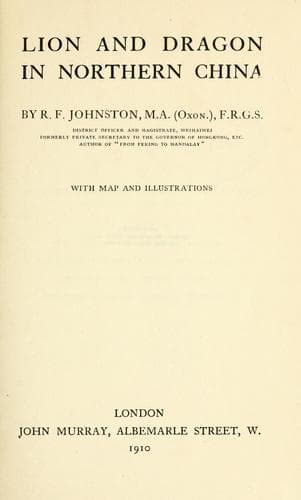
Lion and Dragon in Northern ChinaJohnston, Reginald Fleming, Sir
History
Lion and Dragon in Northern China
Johnston, Reginald Fleming, Sir
Weihai (China) -- History; Weihai (China) -- Social life and customs
But it may be urged that new conditions of service might have been
devised, under which the men of the Chinese Regiment would have been
exempted from the obligation of fighting against their own countrymen.
Against whom, then, could they have fought? They might possibly have
been led against the Japanese, but no one ever supposed for a moment
that they were being trained with a view to action against a Power with
whom Great Britain will probably be the last to quarrel: and in any
case they would have been too few in number to be of effective service
on the field, and by their inability to take an appropriate place among
the other units they might even have been a source of embarrassment.
As for the assistance they might have rendered in the event of an
attack on Weihaiwei by any European Power, it is only necessary to
point out that an infantry regiment would have been totally powerless
to prevent the shelling of Weihaiwei by a naval force, and that if the
British fleet had lost command of the sea, not only the entire Chinese
regiment (or what remained of it after desertions had taken place), but
Weihaiwei itself and all that it contained would have speedily become
prizes of war to the first hostile cruiser that entered the harbour.
It may be said, in conclusion of this topic, that if the British
Government had taken the cynical view that China was doomed to remain
in a chronic state of administrative inefficiency and national
helplessness, it would no doubt have been fully justified, from its own
standpoint, in maintaining the Regiment. That it decided on disbandment
may be regarded as welcome evidence that Great Britain did not, in
1906, take an entirely pessimistic view of China's future.
That the complete withdrawal of all troops was followed by no shadow
of disorder among the people and no increase of crime, strikingly
refutes the argument, sometimes advanced, that the real justification
of the existence of the Regiment was the necessity of relying on a
local armed force for the maintenance of British rule and prestige,
which would otherwise have been outraged or treated with open contempt.
No doubt the Regiment fulfilled a most useful function in suppressing
or preventing disorder and in helping to consolidate British rule
during the eventful year of 1900: and it may very well be that the
people of the Territory then learned the futility of resistance to the
British occupation. But it may be stated with emphasis that since the
disbandment of the Regiment the people--perhaps from a knowledge of the
fact that British troops and warships though not stationed at Weihaiwei
are never very far away--have given no sign whatever of insubordination
or restlessness.[58]
Public-domain text, read in full here on John Shaqi.
Reviews
Reviews
No reviews yet
Be the first to share your thoughts on this work.
Elsewhere in the archive
Join the Discussion
Join the discussion
Sign in to leave a comment or review.
Sign InorCreate an account