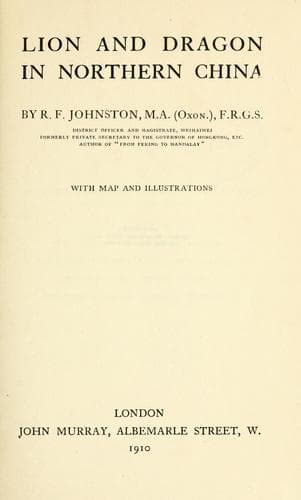
Lion and Dragon in Northern ChinaJohnston, Reginald Fleming, Sir
History
Lion and Dragon in Northern China
Johnston, Reginald Fleming, Sir
Weihai (China) -- History; Weihai (China) -- Social life and customs
It may be said that on the whole the chief fear of the people in
the early days of British administration was not that they or their
families would be slaughtered or dispossessed of their property,
or personally ill-treated, but that they would be overtaxed; and
the disturbances which arose at the time of the delimitation of the
frontier in 1899 and 1900 were in part traceable to wild rumours as to
the means to be adopted by the foreigners for the raising of revenue.
It was thought, for example, that taxes were to be imposed on farmyard
fowls. Taxation has been increased, as a matter of fact, under British
rule. The land-tax (the principal source of revenue) has been doubled,
and licence-fees and dues of various kinds have had the natural result
of raising the price of certain commodities. But these unattractive
features of British rule are on the whole counterbalanced, in the
opinion of the majority of the people, by comparative (though by no
means absolute) freedom from the petty extortions practised by official
underlings in China, by the gradual development of a fairly brisk local
trade, by the influx of money spent in the port by British sailors, by
the facilities given by British merchant ships for the cheap and safe
export of local produce, and by the useful public works undertaken by
Government for direct public benefit.
The amount spent on public improvements is indeed minute compared with
the enormous sums devoted to these purposes in Hongkong, Singapore,
and Kiaochou, yet it forms a respectable proportion of the small local
revenue. That the construction of metalled roads, in particular,
is heartily welcomed throughout the Territory is proved by three
significant facts: in the first place the owners of arable land through
which the new roads pass hardly ever make any demand for pecuniary
compensation, unless they happen to be almost desperately poor;
in the second place, wheeled traffic, which a few years ago would
have been a ludicrous impossibility in any part of the Territory, is
rapidly becoming common; and in the third place the people, on their
own initiative, are extending the road-system in various localities at
their own expense. It may seem almost incredible that, in one case at
least, certain houses that obstructed traffic in a new village road
were voluntarily pulled down by their owners and built further back:
yet not only did they receive no compensation from Government, but
they did not even trouble to report what they had done. Very recently
a petition was received praying the Weihaiwei Government to urge
the Government of Shantung to extend the Weihaiwei road-system into
Chinese territory, especially to the extent of enabling cart traffic
to be opened up between the port of Weihaiwei and the neighbouring
district-cities of Jung-ch'êng, Wên-têng and Ning-hai. The Shantung
Government has been addressed on the subject by the Commissioner of
Weihaiwei, and the Governor has smiled upon the project; though as he
Public-domain text, read in full here on John Shaqi.
Reviews
Reviews
No reviews yet
Be the first to share your thoughts on this work.
Elsewhere in the archive
Join the Discussion
Join the discussion
Sign in to leave a comment or review.
Sign InorCreate an account