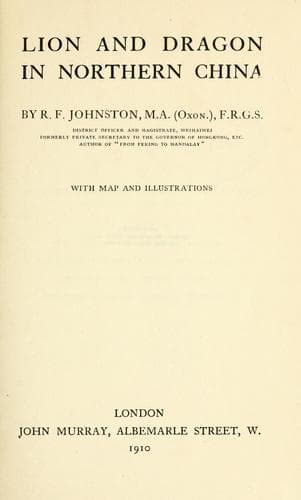
Lion and Dragon in Northern ChinaJohnston, Reginald Fleming, Sir
History
Lion and Dragon in Northern China
Johnston, Reginald Fleming, Sir
Weihai (China) -- History; Weihai (China) -- Social life and customs
has since been transferred to another province it is doubtful whether
anything will be done in the matter at present. So long as Weihaiwei
remains in British hands the Provincial Government, naturally enough,
has no desire to extend the trade facilities of that port to the
possible disadvantage of the Chinese port of Chefoo.
On the whole, the more intelligent members of the native community in
Weihaiwei may be said to be fully conscious of the advantages directly
and indirectly conferred upon them by British rule, though this is far
from implying that they wish that rule to be continued indefinitely.
Some of them are even aware of the fact that they owe many of those
advantages to a philanthropist whom they have never seen--the
uncomplaining (or complaining) British taxpayer. The Territory is, in
fact, so far from being self-supporting that a subsidy of several
thousands of pounds from the British Exchequer is required to meet the
annual deficit in the local budget.[59] The Government is conducted on
extremely economical lines, indeed expenditure has been cut down to
the point of parsimony, yet it is as well to remember that from the
point of view of local resources the administration is costly in the
extreme. A large increase of trade would no doubt soon enable the local
Government to balance its books without assistance from England, but
there are no indications at present that such an expansion is likely to
take place.
British colonial methods do not, as a rule, tolerate a lavish
expenditure on salaries or on needless multiplication of official
posts. In these respects Weihaiwei is not exceptional. There are less
than a dozen Europeans of all grades on the civil establishment, and
of these only four exercise executive or magisterial authority. Since
1906 the whole Territory has been divided for administrative purposes
into twenty-six districts: over each district, which contains on the
average about a dozen villages, presides a native District Headman
(_Tsung-tung_) whose chief duties are to supervise the collection of
the land-tax, to distribute to the separate Village Headmen copies
of all notices and proclamations issued by Government, to distribute
deed-forms to purchasers and sellers of real property, and to use his
influence generally in the interests of peace and good order and in the
discouragement of litigation. For these services he is granted only
five (Mexican) dollars a month from Government, but he is also allowed
a small percentage on the sale of Government deed-forms (for which a
fee is charged) and receives in less regular ways occasional presents,
consisting chiefly of food-stuffs, of which the Government takes no
notice unless it appears that he is using his position as a means of
livelihood or for purposes of extortion.
Public-domain text, read in full here on John Shaqi.
Reviews
Reviews
No reviews yet
Be the first to share your thoughts on this work.
Elsewhere in the archive
Join the Discussion
Join the discussion
Sign in to leave a comment or review.
Sign InorCreate an account