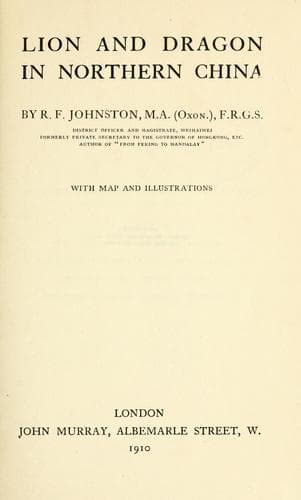
Lion and Dragon in Northern ChinaJohnston, Reginald Fleming, Sir
History
Lion and Dragon in Northern China
Johnston, Reginald Fleming, Sir
Weihai (China) -- History; Weihai (China) -- Social life and customs
When a lawsuit arises out of complicated family disputes, such as
those concerned with inheritance and adoption, there are sometimes
representatives of four generations in the court at the same time.
Babes and small children, if their rights or interests are in any way
involved, are brought into court by their mothers, not with any idea
that the evidence of infants would be accepted, even if it could be
intelligibly given, but merely in order that the magistrate may see
that the children really exist and have not been invented for the
occasion. Sometimes they appear in the court for the practical reason
that all the adults of the family have come to prosecute their lawsuit
and that no one is left at home to take care of them. The presence of
young boys of twelve or fourteen is very useful, as they are often
able to express themselves and even to state the material points of a
case far more briefly and intelligibly than their garrulous elders. If
the case is an important one the court is often filled by cousins and
aunts and interested neighbours of the litigants, and these people are
all ready to swear that plaintiff or defendant, as the case may be, is
a man of pre-eminent virtue who has never committed a wrong action or
entertained an unrighteous thought in his life, while his opponent is a
noted scoundrel who is the terror and bully of the whole countryside.
These exaggerations are merely resorted to as a method of emphasising
one view of the matter in dispute, and are not, as a rule, seriously
intended to mislead the magistrate so much as to give a gentle bias to
his mind. If, as very frequently happens, the magistrate has occasion
to ask a witness why he has made a number of obvious and unnecessary
misstatements, he merely replies with childlike blandness: _Ta_ _jên
mien-ch'ien hsiao-ti pu kan sa huang_--"In the Great Man's presence the
Little One would not dare to tell a lie."
When arguing out their cases in court litigants seldom lose their
temper--always a sign of very "bad form" in China--but they often
assail each other in very vigorous language. Men of some education
often make a show of leaving it to the magistrate to unmask the evil
nature of their opponent. "If the magistrate will only look at that
man's face," they say, "he will see that the fellow is a rogue." The
remark of course implies, and is intended to imply, that the magistrate
is a man of consummate perspicacity who cannot be deceived.
Public-domain text, read in full here on John Shaqi.
Reviews
Reviews
No reviews yet
Be the first to share your thoughts on this work.
Elsewhere in the archive
Join the Discussion
Join the discussion
Sign in to leave a comment or review.
Sign InorCreate an account