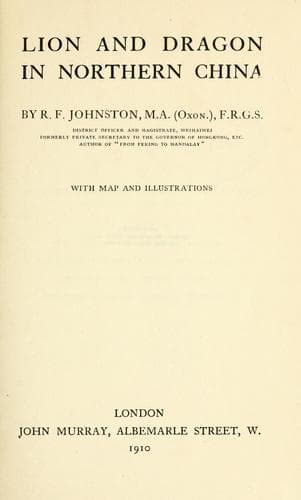
Lion and Dragon in Northern ChinaJohnston, Reginald Fleming, Sir
History
Lion and Dragon in Northern China
Johnston, Reginald Fleming, Sir
Weihai (China) -- History; Weihai (China) -- Social life and customs
The side-lights that legal proceedings throw upon the moral and
intellectual qualities of the people are inexhaustible in their
variety. Under the stress of a burning sense of wrong or dread of
disaster, or in the intensity of his anxiety to win a lawsuit on which
he has staked his happiness, the Chinese, though he still refrains from
what he considers the vulgarity of gesturing, casts to the winds the
reserve and ceremonious decorum of speech that on more placid occasions
often seem to be part of his personality. He can tell lies with
audacity, though his lies indeed are not always rightly so called, and
he has the most extraordinary aptitude for simulating strong emotions
with the object of enlisting judicial sympathy; but, in spite of these
drawbacks, it is during the prosecution of a lawsuit that the strong
and weak elements in his character stand out in strongest relief.
If the litigant can write (though comparatively few of the people
of Weihaiwei can do so) he is allowed to state his case in the form
of a written petition. A typical Chinese petition may be said to be
divided into three parts: firstly, the "case" of the petitioner is
stated in full, strong emphasis being laid on his innate love of right
and his horror of people who disobey the law; secondly, his opponent,
the defendant, is held up to obloquy as a rogue and a hatcher of
villainies; thirdly, the magistrate himself, to whom the petition is
addressed, is cunningly described as having a marvellous faculty for
separating right from wrong, a highly developed sense of justice, and
a peculiarly strong love for law-abiding people. The defendant, when
summoned, will of course adopt similar tactics. If his case is weak and
he has nothing very definite to urge in his own favour, he will try
to prejudice the magistrate against the plaintiff by describing him
as quarrelsome and fond of lawsuits--no small offence in China. His
petition may then run somewhat in these words, which I translate from a
petition recently received: "Plaintiff is an audacious fellow and cares
not how often he goes to law. He is not afraid of officials and loves
litigation. When he comes home from the courts he uses boastful words
and says, 'What fun it is to go to law.'"[67]
Both plaintiff and defendant consider it a good plan to assume an
attitude of weakness, docility, and a constitutional inability to
contend with the woes thrust upon them by a wicked world. "For several
years," says one, "I bore my miseries in silence and dared not take
action, but now things are different, for I have heard the glad news
that the Great Man[68] settles cases as if he were a Spirit."[69] One
of the commonest expressions in a Chinese petition has an odd look when
it is literally translated: "I the Little Man am the Great Man's baby."
Public-domain text, read in full here on John Shaqi.
Reviews
Reviews
No reviews yet
Be the first to share your thoughts on this work.
Elsewhere in the archive
Join the Discussion
Join the discussion
Sign in to leave a comment or review.
Sign InorCreate an account