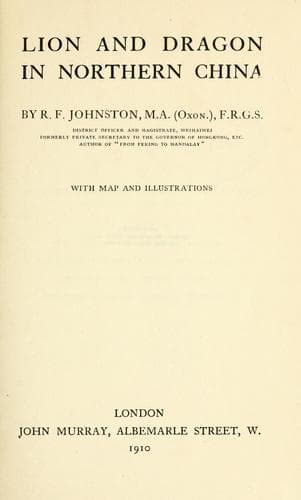
Lion and Dragon in Northern ChinaJohnston, Reginald Fleming, Sir
History
Lion and Dragon in Northern China
Johnston, Reginald Fleming, Sir
Weihai (China) -- History; Weihai (China) -- Social life and customs
A very important point to remember with regard to the selection
of lucky sites for graves is that the solicitude is not only for
the deceased but for the present generation and its descendants as
well.[71] A carefully-selected burial-ground brings, it is believed,
peace to the ancestors down in the Yellow Springs of the Underworld and
also ensures an endless progeny of descendants who will enjoy wealth,
distinction and longevity. The two words _fêng-shui_ mean nothing
more than "wind and water," but their esoteric connotation, if we
were to do it justice, could hardly be elucidated in a whole chapter.
Fêng-shui that was originally good may be ruined through a change in
the course of a river, the erection of new buildings in the immediate
neighbourhood, the opening-up of virgin soil, and through an endless
variety of other causes.
The well-known Chinese dragon often plays a conspicuous part in matters
relating to fêng-shui. To the true believer, indeed, the hills and
rocks are not dead things, but animated with a mysterious kind of life
which is apart from and yet has strange influences over the lives of
men. Threatened disturbances of fêng-shui have frequently been the real
or pretended cause of Chinese opposition to the opening of mines and
the building of railways: and the popular feelings in the matter are so
strong (though they are gradually weakening) that the official classes
are obliged to treat the superstition with an outward respect which
it is fair to say is on their part generally simulated. Yet it is by
no means ignored by the highest in the land: the tombs of the Chinese
imperial family are always selected after a most careful scrutiny of
the spots favoured by the best fêng-shui. The case to which I am about
to allude arose out of a quarrel concerning the proposed opening of a
stone-quarry in the vicinity of an ancestral graveyard. The dialogue
that took place in court proceeded somewhat as follows, though the
speeches are much abbreviated.
_Plaintiffs._--We object to the quarry. The land is defendants'
own and we do not claim any rights over it, but it is close to
our ancestors' graves, and is certain to injure the fêng-shui. We
should not object to a quarry on the far side of the hill, which
cannot be seen from the graveyard. Our ancestors left word that if
a quarry were opened on the far side it would not matter. Why don't
the defendants go to that side?
_Defendants._--The land belongs to us and our deeds are in order.
We assert that plaintiffs have no right to interfere with our
quarry, and we do not see how the fêng-shui of their graves can be
affected. We don't go to the other side of the hill because there
is no stone there.
_Plaintiffs._--There is a dragon in the hill and it lives under the
graveyard, and it extends to the place where the defendants have
wickedly started to quarry. If the hill is cut into, the dragon
will be hurt.
Public-domain text, read in full here on John Shaqi.
Reviews
Reviews
No reviews yet
Be the first to share your thoughts on this work.
Elsewhere in the archive
Join the Discussion
Join the discussion
Sign in to leave a comment or review.
Sign InorCreate an account