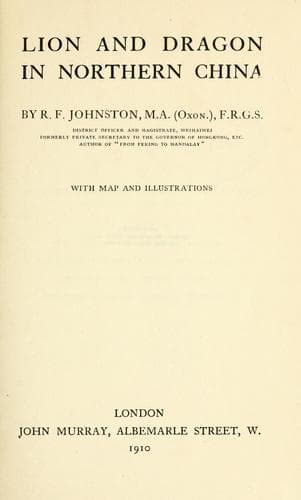
Lion and Dragon in Northern ChinaJohnston, Reginald Fleming, Sir
History
Lion and Dragon in Northern China
Johnston, Reginald Fleming, Sir
Weihai (China) -- History; Weihai (China) -- Social life and customs
In Weihaiwei, litigation arising directly or indirectly out of disputes
concerning coffins is fairly common, owing to the fact that timber
is scarce and good coffins correspondingly expensive. The rights
of ownership over a single tree or a group of trees are for this
reason hotly contested, though the intention of using the timber for
coffin-making is not always mentioned in the pleadings. One T'sung
P'ei-yü made his complaint thus: "I was one of three sons. When the
family property was divided between the three of us by our father's
instructions, my eldest brother was given the house in which we had
been brought up. But in the garden there was a fir-tree, and our
father, before he died, specially declared that this tree was to be
regarded as mine, in order that I might make myself a coffin out of it.
The village headman can bear witness to this, and all the neighbours
know that what 1 say is true. This happened seven years ago, and no one
contested my claim to the tree until the tenth day of this moon, when I
went to the garden to cut it down. To my surprise I was stopped by my
elder brother's wife, Ts'ung Liu Shih, who refused to let me touch it.
I am a man of peace and dared not take the law into my own hands, so I
appeal to the court for help." The end of the case was that some of the
neighbours--doubtless sympathising with the plaintiff in his laudable
and natural longing for a good coffin--offered to "talk peace," and
there was an amicable settlement out of court. The plaintiff got his
tree but had to spend the amount that a good coffin would have cost in
entertaining his genial neighbours at a feast. What became of the elder
brother's wife did not transpire.
From coffins to ancestral worship the transition is easy. Very numerous
cases might be cited in which the magistrate is called upon to decide
subtle questions--such as could seldom arise outside China--connected
with adoption, inheritance, the guardianship of lands devoted to
sacrificial purposes, and the custody of ancestral tablets. During a
journey in western China I had some conversation with a missionary on
this and allied topics. When I mentioned that the ancestral tablets
were frequently produced in court as part of the evidence in a lawsuit
and sometimes remained in the magistrate's custody for several days,
the missionary remarked that he presumed I took advantage of such
occasions to talk seriously to the "heathen" on the wickedness and
folly of "idolatry." The fact that the people of Weihaiwei are still in
the habit of appealing to the British courts for judgments in cases of
this kind, is sufficient to show that the missionary's assumption was
incorrect.
Public-domain text, read in full here on John Shaqi.
Reviews
Reviews
No reviews yet
Be the first to share your thoughts on this work.
Elsewhere in the archive
Join the Discussion
Join the discussion
Sign in to leave a comment or review.
Sign InorCreate an account