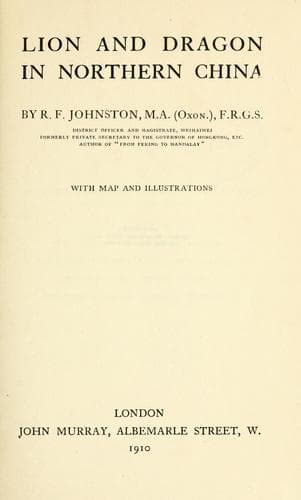
Lion and Dragon in Northern ChinaJohnston, Reginald Fleming, Sir
History
Lion and Dragon in Northern China
Johnston, Reginald Fleming, Sir
Weihai (China) -- History; Weihai (China) -- Social life and customs
The Chinese magistrate being in theory the father of his district, he
must not merely hold the balance between his people when they come to
him with their quarrels; he must not merely punish the offender and
vindicate the cause of the oppressed: he must also instil into the
minds of his "children," by word and example, a submissive reverence
for the doctrines of the ancient sages, which include proper respect
for tradition, a dutiful obedience to all properly-constituted
authority, whether in family or in State, and the practice of courtesy
and forbearance in all dealings with neighbours and strangers. Some
of the most valuable of the Confucian maxims are summed up in the
"Sacred Edict," which, though it only dates from the time of K'ang Hsi
(seventeenth century), is entirely based on the Confucian teachings
and is very well known--by name if not by its contents--to the vast
majority of the Chinese people. Whether Chinese magistrates always
fulfil their functions either as models or as teachers of virtue is a
matter which does not concern us.
In Weihaiwei, where the King's Order-in-Council justifies a magistrate
in giving effect to Chinese customs and practices, I have frequently,
in delivering judgments in both civil and criminal cases, used
appropriate texts taken either from the Confucian classics themselves
or from the Sacred Edict, for the purpose of giving my hearers little
moral discourses on points suggested by the cases before me. If, for
example, two neighbours have quarrelled over some trifling matter I
tell them of the wise words used by K'ang Hsi and his commentators
with reference to the observance of harmonious relations among people
who inhabit the same village. I remind them, perhaps, that "if
fellow-villagers quarrel with one another and neither is willing to
forgive, then the result will be a state of enmity which may not only
last all their own lives, but may embitter the lives of their sons and
grandsons, and even then peace may not ensue."
On one occasion on which I had quoted a passage from the Sacred Edict a
local missionary pointed out to me that I could have found a far more
appropriate text for my purpose by turning to a certain passage in the
Bible to which he referred me. He was very probably quite right, though
I did not verify his Biblical reference: but it would no more occur
to me, in addressing a crowd of Chinese from the magisterial bench in
Weihaiwei, to read them passages from the Bible than it would occur to
a judge in England to entertain the jury or the prisoner at the bar
with quotations from the Zend Avesta or the Institutes of Vishnu. Is
it not probable that an ordinary Chinese peasant will think more of
his magistrate's ethical views and be more likely to profit by them if
the magistrate bases his discourses on teachings which the Chinese and
his ancestors have always been taught to hold sacred, rather than on
strange-sounding quotations from a book he has never heard of?
Public-domain text, read in full here on John Shaqi.
Reviews
Reviews
No reviews yet
Be the first to share your thoughts on this work.
Elsewhere in the archive
Join the Discussion
Join the discussion
Sign in to leave a comment or review.
Sign InorCreate an account