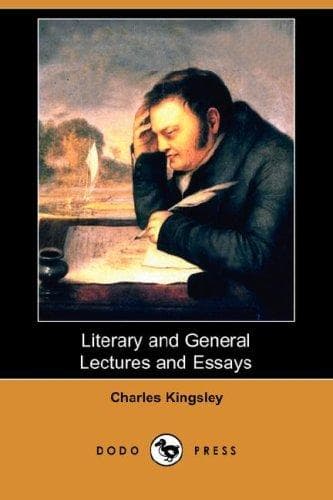
Literary and General Lectures and EssaysKingsley, Charles
History
Literary and General Lectures and Essays
Kingsley, Charles
English literature -- History and criticism
Not that we ask any one to sit down, and, out of mere benevolence, to
write songs for the people. Wooden out of a wooden birthplace, would
such go forth, to feed fires, not spirits. But if any man shall read
these pages, to whom God has given a truly poetic temperament, a
gallant heart, a melodious ear, a quick and sympathetic eye for all
forms of human joy, and sorrow, and humour, and grandeur; an insight
which can discern the outlines of the butterfly, when clothed in the
roughest and most rugged chrysalis-hide; if the teachers of his heart
and purposes, and not merely of his taste and sentiments, have been
the great songs of his own and of every land and age; if he can see
in the divine poetry of David and Solomon, of Isaiah and Jeremiah,
and, above all, in the parables of Him who spake as never man spake,
the models and elemental laws of a people's poetry, alike according
to the will of God and the heart of man; if he can welcome gallantly
and hopefully the future, and yet know that it must be, unless it
would be a monster and a machine, the loving and obedient child of
the past; if he can speak of the subjects which alone will interest
the many, on love, marriage, the sorrows of the poor, their hopes,
political and social, their wrongs, as well as their sins and duties;
and that with a fervour and passion akin to the spirit of Burns and
Elliott, yet with more calmness, more purity, more wisdom, and
therefore with more hope, as one who stands upon a vantage-ground of
education and culture, sympathising none the less with those who
struggle behind him in the valley of the shadow of death, yet seeing
from the mountain peaks the coming dawn, invisible as yet to them:
then let that man think it no fall, but rather a noble rise, to leave
awhile the barren glacier ranges of pure art, for the fertile gardens
of practical and popular song, and write for the many, and with the
many, in words such as they can understand; remembering that that
which is simplest is always deepest; that the many contain in
themselves the few; and that when he speaks to the wanderer and the
drudge, he speaks to the elemental and primeval man, and in him
speaks to all who have risen out of him. Let him try, undiscouraged
by inevitable failures; and if at last he succeeds in giving vent to
one song which will cheer hard-worn hearts at the loom and the forge,
or wake one pauper's heart with the hope that his children are
destined not to die as he died, or recall, amid Canadian forests or
Australian sheep-walks, one thrill of love for the old country, her
liberties, and her laws, and her religion, to the settler's heart--
let that man know that he has earned a higher place among the spirits
of the wise and good, by doing, in spite of the unpleasantness of
self-denial, the duty which lay nearest him, than if he had out-
rivalled Goethe on his own classic ground, and made all the
cultivated and the comfortable of the earth desert, for the exquisite
Public-domain text, read in full here on John Shaqi.
Reviews
Reviews
No reviews yet
Be the first to share your thoughts on this work.
Elsewhere in the archive
Join the Discussion
Join the discussion
Sign in to leave a comment or review.
Sign InorCreate an account