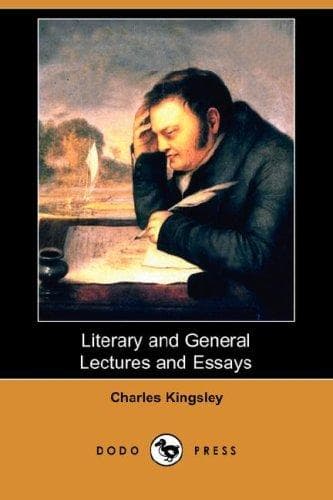
Literary and General Lectures and EssaysKingsley, Charles
History
Literary and General Lectures and Essays
Kingsley, Charles
English literature -- History and criticism
This is the mystic idea, pure and simple; of course there are various
grades of it, as there are of the popular one; for no man holds his
own creed and nothing more; and it is good for him, in this piecemeal
and shortsighted world, that he should not. Were he over-true to his
own idea, he would become a fanatic, perhaps a madman. And so the
modern evangelical of the Venn and Newton school, to whom mysticism
is neology and nehushtan, when he speaks of "spiritual experiences,"
uses the adjective in its purely mystic sense; while Bernard of
Cluny, in his once famous hymn, "Hic breve vivitur," mingles the two
conceptions of the unseen world in inextricable confusion. Between
these two extreme poles, in fact, we have every variety of thought;
and it is good for us that we should have them; for no one man or
school of men can grasp the whole truth, and every intermediate
modification supplies some link in the great cycle of facts which its
neighbours have overlooked.
In the minds who have held this belief, that the unseen world is the
only real and eternal one, there has generally existed a belief, more
or less confused, that the visible world is in some mysterious way a
pattern or symbol of the invisible one; that its physical laws are
the analogues of the spiritual laws of the eternal world: a belief
of which Mr. Vaughan seems to think lightly; though if it be untrue
we can hardly see how that metaphoric illustration in which he
indulges so freely, and which he often uses in a masterly and
graceful way, can be anything but useless trifling. For what is a
metaphor or a simile but a mere paralogism--having nothing to do with
the matter in hand, and not to be allowed for a moment to influence
the reader's judgment, unless there be some real and objective
analogy--homology we should call it--between the physical phenomenon
from which the symbol is taken, and the spiritual truth which it is
meant to illustrate? What divineness, what logical weight, in our
Lord's parables, unless He was by them trying to show his hearers
that the laws which they saw at work in the lilies of the field, in
the most common occupations of men, were but lower manifestations of
the laws by which are governed the inmost workings of the human
spirit? What triflers, on any other ground, were Socrates and Plato.
What triflers, too, Shakespeare and Spenser. Indeed, we should say
that it is the belief, conscious or unconscious, of the eternal
correlation of the physical and spiritual worlds, which alone
constitutes the essence of a poet.
Public-domain text, read in full here on John Shaqi.
Reviews
Reviews
No reviews yet
Be the first to share your thoughts on this work.
Elsewhere in the archive
Join the Discussion
Join the discussion
Sign in to leave a comment or review.
Sign InorCreate an account