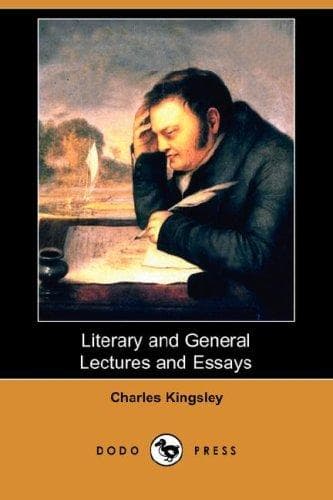
Literary and General Lectures and EssaysKingsley, Charles
History
Literary and General Lectures and Essays
Kingsley, Charles
English literature -- History and criticism
Of course this idea led, and would necessarily lead, to follies and
fancies enough, as long as the phenomena of nature were not carefully
studied, and her laws scientifically investigated; and all the dreams
of Paracelsus or Van Helmont, Cardan or Crollius, Baptista Porta or
Behmen, are but the natural and pardonable errors of minds which,
while they felt deeply the sanctity and mystery of Nature, had no
Baconian philosophy to tell them what Nature actually was, and what
she actually said. But their idea lives still, and will live as long
as the belief in a one God lives. The physical and spiritual worlds
cannot be separated by an impassable gulf. They must, in some way or
other, reflect each other, even in their minutest phenomena, for so
only can they both reflect that absolute primeval unity, in whom they
both live and move and have their being. Mr. Vaughan's object,
however, has not been to work out in his book such problems as these.
Had he done so, he would have made his readers understand better what
Mysticism is; he would have avoided several hasty epithets, by the
use of which he has, we think, deceived himself into the notion that
he has settled a matter by calling it a hard name; he would have
explained, perhaps, to himself and to us, many strange and seemingly
contradictory facts in the annals of Mysticism. But he would also
not have written so readable a book. On the whole he has taken the
right course, though one wishes that he had carried it out more
methodically.
A few friends, literate and comfortable men, and right-hearted
Christians withal, meet together to talk over these same mystics, and
to read papers and extracts which will give a general notion of the
subject from the earliest historic times. The gentlemen talk about
and about a little too much; they are a little too fond of
illustrations of the popular pulpit style; they are often apt to say
each his say, with very little care of what the previous speaker has
uttered; in fact these conversations are, as conversations, not good,
but as centres of thought they are excellent. There is not a page
nor a paragraph in which there is not something well worth
recollecting, and often reflections very wise and weighty indeed,
which show that whether or not Mr. Vaughan has thoroughly grasped the
subject of Mysticism, he has grasped and made part of his own mind
and heart many things far more practically important than Mysticism,
or any other form of thought; and no one ought to rise up from the
perusal of his book without finding himself if not a better, at least
a more thoughtful man, and perhaps a humble one also, as he learns
how many more struggles and doubts, discoveries, sorrows and joys,
the human race has passed through, than are contained in his own
private experience.
Public-domain text, read in full here on John Shaqi.
Reviews
Reviews
No reviews yet
Be the first to share your thoughts on this work.
Elsewhere in the archive
Join the Discussion
Join the discussion
Sign in to leave a comment or review.
Sign InorCreate an account