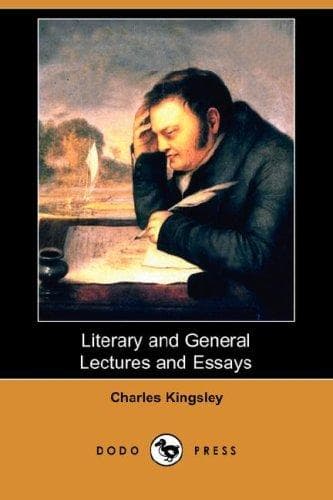
Literary and General Lectures and EssaysKingsley, Charles
History
Literary and General Lectures and Essays
Kingsley, Charles
English literature -- History and criticism
them his own little system of the Universe, and found a school or
sect; and at last by steady and necessary degradation, mainly to feed
his own vanity and his own animal sense of power.
But Mr. Maurice, above all men whom I have ever met, conquered both
these temptations. For, first, he had no system of the Universe. To
have founded a sect, or even a school, would be, he once said, a sure
sign that he was wrong and was leading others wrong. He was a
Catholic and a Theologian, and he wished all men to be such likewise.
To be so, he held, they must know God in Christ. If they knew God,
then with them, as with himself, they would have the key which would
unlock all knowledge, ecclesiastical, eschatological (religious, as
it is commonly called), historic, political, social. Nay even, so he
hoped, that knowledge of God would prove at last to be the key to the
right understanding of that physical science of which he,
unfortunately for the world, knew but too little, but which he
accepted with a loyal trust in God, and in fact as the voice of God,
which won him respect and love from men of science to whom his
theology was a foreign world. If he could make men know God, and
therefore if he could make men know that God was teaching them; that
no man could see a thing unless God first showed it to him--then all
would go well, and they might follow the Logos, with old Socrates,
whithersoever he led. Therefore he tried not so much to alter men's
convictions, as, like Socrates, to make them respect their own
convictions, to be true to their own deepest instincts, true to the
very words which they used so carelessly, ignorant alike of their
meaning and their wealth. He wished all men, all churches, all
nations, to be true to the light which they had already, to
whatsoever was godlike, and therefore God-given, in their own
thoughts; and so to rise from their partial apprehensions, their
scattered gleams of light, toward that full knowledge and light which
was contained--so he said, even with his dying lips--in the orthodox
Catholic faith. This was the ideal of the man and his work; and it
left him neither courage nor time to found a school or promulgate a
system. God had His own system: a system vaster than Augustine's,
vaster than Dante's, vaster than all the thoughts of all thinkers,
orthodox and heterodox, put together; for God was His own system, and
by Him all thing's consisted, and in Him they lived and moved and had
their being; and He was here, living and working, and we were living
and working in Him, and had, instead of building systems of our own,
to find out His eternal laws for men, for nations, for churches; for
only in obedience to them is Life. Yes, a man who held this could
found no system. "Other foundation," he used to say, "can no man
lay, save that which is laid, even Jesus Christ." And as he said it,
his voice and eye told those who heard him that it was to him the
Public-domain text, read in full here on John Shaqi.
Reviews
Reviews
No reviews yet
Be the first to share your thoughts on this work.
Elsewhere in the archive
Join the Discussion
Join the discussion
Sign in to leave a comment or review.
Sign InorCreate an account