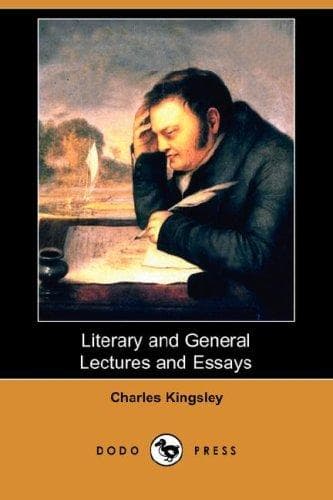
Literary and General Lectures and EssaysKingsley, Charles
History
Literary and General Lectures and Essays
Kingsley, Charles
English literature -- History and criticism
most potent, the most inevitable, the most terrible, and yet the most
hopeful, of all facts.
As for temptations to vanity, and love of power--he may have had to
fight with them in the heyday of youth, and genius, and perhaps
ambition. But the stories of his childhood are stories of the same
generosity, courtesy, unselfishness, which graced his later years.
At least, if he had been tempted, he had conquered. In more than
five-and-twenty years, I have known no being so utterly unselfish, so
utterly humble, so utterly careless of power or influence, for the
mere enjoyment--and a terrible enjoyment it is--of using them.
Staunch to his own opinion only when it seemed to involve some moral
principle, he was almost too ready to yield it, in all practical
matters, to anyone whom he supposed to possess more practical
knowledge than he. To distrust himself, to accuse himself, to
confess his proneness to hard judgments, while, to the eye of those
who knew him and the facts, he was exercising a splendid charity and
magnanimity; to hold himself up as a warning of "wasted time," while
he was, but too literally, working himself to death--this was the
childlike temper which made some lower spirits now and then glad to
escape from their consciousness of his superiority by patronising and
pitying him; causing in him--for he was, as all such great men are
like to be, instinct with genial humour--a certain quiet good-natured
amusement, but nothing more.
But it was that very humility, that very self-distrust, combined so
strangely with manful strength and sternness, which drew to him
humble souls, self-distrustful souls, who, like him, were full of the
"Divine discontent;" who lived--as perhaps all men should live--angry
with themselves, ashamed of themselves, and more and more angry and
ashamed as their own ideal grew, and with it their consciousness of
defection from that ideal. To him, as to David in the wilderness,
gathered those who were spiritually discontented and spiritually in
debt; and he was a captain over them, because, like David, he talked
to them, not of his own genius or his own doctrines, but of the
Living God, who had helped their forefathers, and would help them
likewise. How great his influence was; what an amount of teaching,
consolation, reproof, instruction in righteousness, that man found
time to pour into heart after heart, with a fit word for man and for
woman; how wide his sympathies, how deep his understanding of the
human heart; how many sorrows he has lightened; how many wandering
feet set right, will never be known till the day when the secrets of
all hearts are disclosed. His forthcoming biography, if, as is
hoped, it contains a selection from his vast correspondence, will
tell something of all this: but how little! The most valuable of
his letters will be those which were meant for no eye but the
recipient's, and which no recipient would give to the world--hardly
Public-domain text, read in full here on John Shaqi.
Reviews
Reviews
No reviews yet
Be the first to share your thoughts on this work.
Elsewhere in the archive
Join the Discussion
Join the discussion
Sign in to leave a comment or review.
Sign InorCreate an account