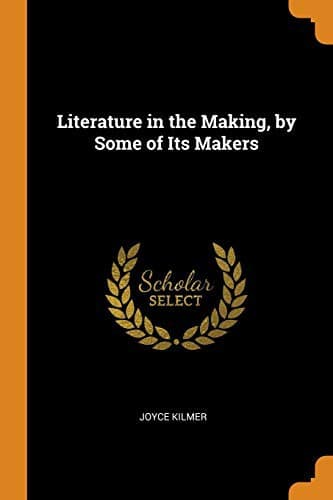
American literature -- History and criticism; Authors, American
They knew that through me they spoke, in the first place, to the great
army of readers of their books who have a natural and pleasing curiosity
concerning the personality of the men and women who devote their lives
to providing them with entertainment, and, in some cases, instruction.
They knew that through me they spoke, in the second place, to all the
literary apprentices of the country, who look eagerly for precept and
example to those who have won fame by the delightful labor of writing.
They knew that through me they spoke, in the third place, to critics and
students of literature of our own generation and, perhaps, of those that
shall come after us. How eagerly would we read, for instance, an
interview with Francis Bacon on the question of the authorship of
Shakespeare's plays, or an interview with Oliver Goldsmith in which he
gave his real opinion of Dr. Johnson, Garrick, and Boswell! A century or
so from now, some of the writers who in this book talk to the world may
be the objects of curiosity as great.
The writers who have talked with me received me with courtesy, gave me
freely of their time and thought, and showed a sincere desire for the
furtherance of the purpose of this book. To them, accordingly, I tender
my gratitude for anything in these pages which the reader may find of
interest or of value. Their explanations of their literary creeds and
practices were furnished in the first instance for the _New York Times_,
to which I desire to express my acknowledgments.
JOYCE KILMER.
LITERATURE IN THE MAKING
_WAR STOPS LITERATURE_
WILLIAM DEAN HOWELLS
War stops literature. This is the belief of a man who for more than a
quarter of a century has been in the front rank of the world's
novelists, who wrote _The Rise of Silas Lapham_ and _A Modern Instance_
and nearly a hundred other sympathetic interpretations of American life.
Mr. William Dean Howells was the third writer to whom was put the
question, "What effect will the Great War have on literature?" And he
was the first to give a direct answer.
A famous French dramatist replied: "I am not a prophet. I have enough to
do to understand the present and the past; I cannot concern myself with
the future." A famous English short-story writer said, "The war has
already inspired some splendid poetry; it may also inspire great plays
and novels, but, of course, we cannot tell as yet."
But Mr. Howells said, quite simply, "War stops literature." He said it
as unemotionally as if he were stating a familiar axiom.
He does not consider it an axiom, however, for he supplied proof.
"I have never believed," he said, "that great events produced great
literature. They seldom call forth the great creative powers of man. In
poetry it is not the poems of occasion that endure, but the poems that
have come into being independently, not as the result of momentous
happenings.
Public-domain text, read in full here on John Shaqi.
Reviews
Reviews
No reviews yet
Be the first to share your thoughts on this work.
Join the Discussion
Join the discussion
Sign in to leave a comment or review.
Sign InorCreate an account