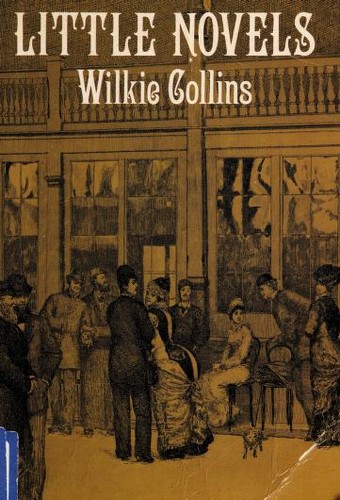
England -- Social life and customs -- 19th century -- Fiction
Under the dull gray light I saw the grass move--but not as it had moved,
on the day before. It shriveled as if a flame had scorched it. No flame
appeared. The brown underlying earth showed itself winding onward in
a thin strip--which might have been a footpath traced in fire. It
frightened me. I longed for the protection of the Invisible Presence. I
prayed for a warning of it, if danger was near.
A touch answered me. It was as if a hand unseen had taken my hand--had
raised it, little by little--had left it, pointing to the thin brown
path that wound toward me under the shriveled blades of grass.
I looked to the far end of the path.
The unseen hand closed on my hand with a warning pressure: the
revelation of the coming danger was near me--I waited for it. I saw it.
The figure of a man appeared, advancing toward me along the thin brown
path. I looked in his face as he came nearer. It showed me dimly the
face of my husband's brother--John Zant.
The consciousness of myself as a living creature left me. I knew
nothing; I felt nothing. I was dead.
When the torture of revival made me open my eyes, I found myself on the
grass. Gentle hands raised my head, at the moment when I recovered my
senses. Who had brought me to life again? Who was taking care of me?
I looked upward, and saw--bending over me--John Zant.
VII.
THERE, the manuscript ended.
Some lines had been added on the last page; but they had been so
carefully erased as to be illegible. These words of explanation appeared
below the canceled sentences:
"I had begun to write the little that remains to be told, when it struck
me that I might, unintentionally, be exercising an unfair influence on
your opinion. Let me only remind you that I believe absolutely in the
supernatural revelation which I have endeavored to describe. Remember
this--and decide for me what I dare not decide for myself."
There was no serious obstacle in the way of compliance with this
request.
Judged from the point of view of the materialist, Mrs. Zant might no
doubt be the victim of illusions (produced by a diseased state of the
nervous system), which have been known to exist--as in the celebrated
case of the book-seller, Nicolai, of Berlin--without being accompanied
by derangement of the intellectual powers. But Mr. Rayburn was not
asked to solve any such intricate problem as this. He had been merely
instructed to read the manuscript, and to say what impression it had
left on him of the mental condition of the writer; whose doubt of
herself had been, in all probability, first suggested by remembrance of
the illness from which she had suffered--brain-fever.
Under these circumstances, there could be little difficulty in forming
an opinion. The memory which had recalled, and the judgment which had
arranged, the succession of events related in the narrative, revealed a
mind in full possession of its resources.
Public-domain text, read in full here on John Shaqi.
Reviews
Reviews
No reviews yet
Be the first to share your thoughts on this work.
Join the Discussion
Join the discussion
Sign in to leave a comment or review.
Sign InorCreate an account