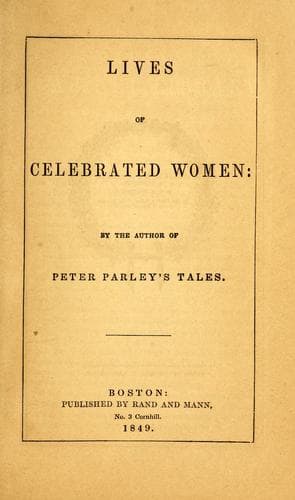
Lives of Celebrated WomenGoodrich, Samuel G. (Samuel Griswold)
History
Lives of Celebrated Women
Goodrich, Samuel G. (Samuel Griswold)
Women -- Biography
In spite, however, of all the interruptions of company and of
sickness; for, as she tells us, "From early infancy to late old age,
her life was a successive scene of visitation and restoration," she
found time and strength to compose a series of works on "Morals,"--the
last of the three being produced in the seventy-fifth year of her
age.
In 1828, Miss More was subjected to the severest trial, perhaps, of
her life. After the death of her sister Martha, who had been the
manager of the domestic economy of the sisterhood, affairs at Barley
Wood got into sad confusion. Dishonest and dissolute servants wasted
her substance. After trying in vain to correct the evil by mild
remonstrance, she sank quietly under what seemed inevitable, and
determined to take the infliction as a chastisement to which it was
her duty to submit. At length, however, her friends interposed, and
represented to her the danger of her appearing as the patroness of
vice, and thereby lessening the influence of her writings. It was
determined that her establishment should be broken up. At a bleak
season of the year, on a cold and inclement day, after a long
confinement to her chamber, she removed to Clifton. From her apartment
she was attended by several of the principal gentlemen of the
neighborhood, who had come to protect her from the approach of any
thing that might discompose her. She descended the stairs with a
placid countenance, and walked silently for a few minutes round the
lower room, the walls of which were covered with the portraits of her
old and dear friends, who had successively gone before her. As she was
helped into the carriage, she cast one pensive, parting look upon her
bowers, saying, "I am driven, like Eve, out of paradise; but not, like
Eve, by angels." From the shock of the discovery of the misconduct of
her servants, Miss More never recovered. After her removal to Clifton,
her health was in a very precarious state. To her friends and admirers
it was painful to see her great and brilliant talents descending to
the level of mere ordinary persons; but the good, the kind, the
beneficent qualities of her mind suffered no diminution or abatement.
So long as her intellectual faculties remained but moderately
impaired, her wonted cheerfulness and playfulness of disposition did
not forsake her; and no impatient or querulous expressions escaped her
lips, even in moments of painful suffering. Thus free from the
infirmities of temper, which often render old age unamiable and
unhappy, she was also spared many of the bodily infirmities which
often accompany length of years. To the very last her eye was not dim;
she could read with ease, and without spectacles, the smallest print.
Her bearing was almost unimpaired, and, until very near the close of
her life, her features were not wrinkled or uncomely. Her death-bed
was attended with few of the pains and infirmities which are almost
inseparable from sinking nature. She looked serene, and her breathing
Public-domain text, read in full here on John Shaqi.
Reviews
Reviews
No reviews yet
Be the first to share your thoughts on this work.
Elsewhere in the archive
Join the Discussion
Join the discussion
Sign in to leave a comment or review.
Sign InorCreate an account