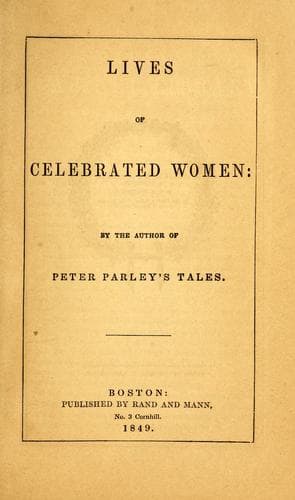
Lives of Celebrated WomenGoodrich, Samuel G. (Samuel Griswold)
History
Lives of Celebrated Women
Goodrich, Samuel G. (Samuel Griswold)
Women -- Biography
It excited such immediate and universal attention,
that, in a few days after its first appearance, she received notice to
prepare for a second edition; and shortly afterwards she was followed
to Dawlish, whither she had gone to try the effect of repose and the
sea air, in restoring her health, by the eleventh edition.
Her works at an early period were duly estimated in the United
States, and of the "Coelebs" thirty editions had been issued
before the author's death. It is not a little creditable to the
public taste, that a work so full of plain and practical truth
should be so well received. In "Coelebs," as well as in some of her
smaller productions, Miss More evinces her power of invention, and
gives proof that, had she chosen to employ fiction as the vehicle
of instruction, her imagination would have afforded her abundant
resources; but habit and the bias of her mind led her in another
course: a certain substantiality of purpose, a serious devotion to
decided and direct beneficence, an active and almost restless
principle of philanthropy, were the great distinctions of her
character.
When the education of the Princess Charlotte became a subject of
serious attention and inquiry, the advice and assistance of Miss More
were requested by the queen. Bishop Porteus strenuously advised that
the education should be intrusted to her; but, when the latter
required that the _entire_ direction should be given to her charge,
this was thought, by those in power, to be too great a confidence.
They were willing to engage her in a subordinate capacity; but this
she declined, and so the negotiation ended. Her ideas on the subject
were given to the world under the title of "Hints for forming the
Character of a Young Princess"--a book which subsequently was a great
favorite with her for whose benefit it was intended, and doubtless
contributed to the formation of those virtues and principles which
made her death so much lamented.
In the country Miss More had hoped to find retirement. But Barley
Wood--a place to which she had removed, about one mile from Cowslip
Green--was any thing but a hermitage. "Though," she says, "I neither
return visits nor give invitations, except when quite confined by
sickness, I think I never saw more people, known and unknown, in my
gayest days. I never had so many cares and duties imposed upon me as
now in sickness and old age. I know not how to help it. If my guests
are old, I see them out of respect, and in the hope of receiving some
good; if young, I hope I may do them a little good; if they come from
a distance, I feel as if I ought to see them on that account; if near
home, my neighbors would be jealous of my seeing strangers, and
excluding them." Her epistolary labors were enormous. She laid it down
as a rule never to refuse or delay answering any application for
epistolary advice, enduring the incessant interruptions with
indefatigable kindness.
Public-domain text, read in full here on John Shaqi.
Reviews
Reviews
No reviews yet
Be the first to share your thoughts on this work.
Elsewhere in the archive
Join the Discussion
Join the discussion
Sign in to leave a comment or review.
Sign InorCreate an account