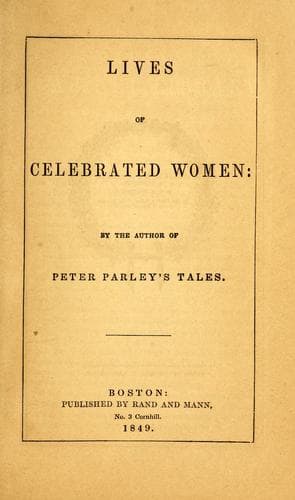
Lives of Celebrated WomenGoodrich, Samuel G. (Samuel Griswold)
History
Lives of Celebrated Women
Goodrich, Samuel G. (Samuel Griswold)
Women -- Biography
The union of Scotland to England had ever been a favorite project with
English sovereigns, and the present seemed to Henry VIII. a favorable
opportunity for peaceably effecting it. He lost no time, therefore, in
proposing a match between the infant queen and his own son, Edward.
His proposal found little favor; the haughty nobles could not endure
to see their country become a mere province of England; and the queen
mother and her religious advisers feared for the security of the
Catholic religion. Henry might, however, have ultimately succeeded,
had he acted with prudence. But he sought to terrify the Scots into
submission; and those who succeeded to the government of England upon
his death, which happened soon after, persisted in the same policy. An
army was sent into Scotland, to ravage the country and pillage the
towns and villages. This mode of wooing did not suit the temper of the
Scots; and an end was soon put to all hopes by the negotiation of a
marriage treaty between the queen and Francis, the infant dauphin of
France. In pursuance of this treaty, Mary, then in her sixth year, was
sent to France to be educated. She was at first placed in a convent
with the king's daughters, where she made a rapid progress in all the
accomplishments they attempted to teach her. Here her enthusiastic
disposition was so strongly impressed with religious feelings, and she
evinced such a fondness for a cloistered life, that it was thought
proper to remove her to the gayer scenes of the court--a change which
cost her torrents of tears. The fashion for learning prevailed at
this time, and Mary profited by it. Her instructors were the most
eminent men of the time; Buchanan taught her Latin; Pasquier
instructed her in history; Ronsard, the most famous of the early
French poets, cultivated her taste for poetry: they found her not only
a willing but an able pupil. Other accomplishments were not neglected;
she sung, and played on the lute and the virginals; she rode on
horseback fearlessly, yet with feminine grace; her dancing was always
admired; and we are assured that in the Spanish minuet she was
equalled only by her aunt, the beautiful Anne of Este, and no lady of
the court could eclipse her in a galliarde. Her beauty and the
charming expression of her countenance were such, that, as a
contemporary asserts, "no one could look upon her without loving her."
When her mother came over to visit her in 1550, she burst into tears
of joy, and congratulated herself on her daughter's capacity and
loveliness. Soon after Mary's marriage to Francis, in 1558, Elizabeth
ascended the English throne; the pope, and the French and Spanish
courts, refused to acknowledge her; and Mary, undisputably the next
heir, was compelled by the commands of her father-in-law to assume the
title and arms of queen of England--a measure of unforeseen but fatal
consequences to her, as it added fresh fuel to the fires of envy,
jealousy, and hatred, which the personal advantages of Mary had
Public-domain text, read in full here on John Shaqi.
Reviews
Reviews
No reviews yet
Be the first to share your thoughts on this work.
Elsewhere in the archive
Join the Discussion
Join the discussion
Sign in to leave a comment or review.
Sign InorCreate an account