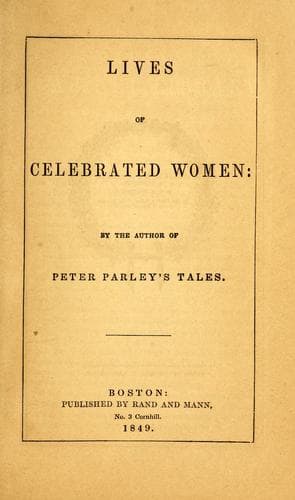
Lives of Celebrated WomenGoodrich, Samuel G. (Samuel Griswold)
History
Lives of Celebrated Women
Goodrich, Samuel G. (Samuel Griswold)
Women -- Biography
already excited in the bosom of her vain and vindictive rival.
[Illustration: MARY, QUEEN OF SCOTS, AT WINFIELD CASTLE.]
In 1558, Francis and Mary were crowned king and queen of France.
Francis survived this event but a few months. He was far inferior to
his wife, both in personal and mental accomplishments; he was of
sickly constitution, and very reserved; but he had an affectionate and
kind disposition. He was not a man to call forth the deepest and most
passionate feelings of such a heart as Mary's; but she ever treated
him with tenderness and most respectful attention. She is described by
an eye-witness as a "sorrowful widow," and lamented her husband
sincerely.
The happiness of Mary's life was now at an end. She was a stranger in
the land of which she had so recently been crowned queen. In the queen
mother, the ambitious Catherine de Medicis, who now ruled France in
the name of her son Charles IX., Mary had an inveterate foe. In the
reign of Francis they had been rivals for power, when the charms of
the wife had triumphed over the authority of the mother. There was
another wound which had long rankled in the vindictive bosom of
Catherine. In the artlessness of youth, Mary had once boasted of her
own descent from a "hundred kings," which was supposed to reflect on
the mercantile lineage of the daughter of the Medicis. She now took
her revenge. By the most studied slights she sought to mortify Mary,
who first retired to Rheims. Here she was waited on by a deputation
from her own nobles, who invited her, in terms which amounted to a
command, to return to her native country.
A new cause of difficulty now occurred between Mary and Elizabeth. The
heads of the reformed religious party in Scotland, called the "Lords
of the Congregation," had negotiated a treaty with Elizabeth, one of
the terms of which was a renunciation, on the part of Mary, of all
claims to the crown of England forever. This Mary refused to ratify,
and replied to the crafty ministers of her rival with a spirit,
intelligence, and firmness, extraordinary in a girl of eighteen. At
the same time, she was courteous and gentle, and apologized for the
assumption of the title and arms of queen of England, which, at the
death of her husband, she had renounced. Attempts had been made to
excite the fears of her Protestant subjects, which she thus set at
rest: "I will be plain with you; the religion I profess I take to be
the most acceptable to God; and indeed I neither know nor desire any
other. I have been brought up in this religion, and who might credit
me in any thing if I should show myself light in this case? I am none
of those who change their religion every year; but I mean to constrain
none of my subjects, though I could wish they were all as I am; and I
trust they shall have no support to constrain me."
Public-domain text, read in full here on John Shaqi.
Reviews
Reviews
No reviews yet
Be the first to share your thoughts on this work.
Elsewhere in the archive
Join the Discussion
Join the discussion
Sign in to leave a comment or review.
Sign InorCreate an account