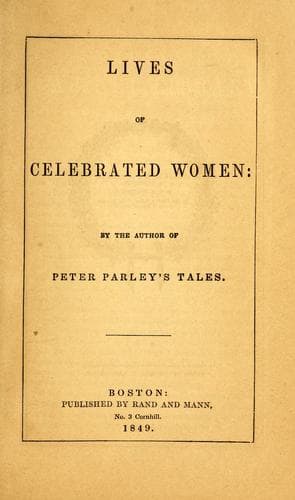
Lives of Celebrated WomenGoodrich, Samuel G. (Samuel Griswold)
History
Lives of Celebrated Women
Goodrich, Samuel G. (Samuel Griswold)
Women -- Biography
A literary friend, to whom these verses were shown, felt some doubts
as to Lucretia's being the real author of the stanzas, and suffered
them to appear. The feeling that her rectitude was impeached made the
sensitive girl actually ill; but a poetic remonstrance, which she
prepared on the occasion, removed every doubt.
From what has been before said, it must not be supposed that Lucretia
was suffered to abandon herself to literary avocations. She had her
prescribed tasks in sewing, and other customary employments, which she
generally performed with fidelity and with wonderful celerity;
sometimes, however, the voice of her muse struck her in the midst, and
"enchanted she dropped each earthly care." One day, she had promised
to do a certain piece of sewing, and had eagerly run for her basket;
she was absent long, and on her return found that the work was done.
"Where have you been, Lucretia?" said her mother, justly displeased.
"O mamma," she replied, "I did forget; I am grieved. As I passed the
window, I saw a solitary sweet pea. I thought they were all gone. This
was alone. I ran to smell it, but, before I could reach it, a gust of
wind broke the stem. I turned away disappointed, and was coming back
to you; but as I passed the table, there stood the inkstand, and I
forgot you." The following beautiful verses insured the forgiveness of
her mother:--
"The last flower of the garden was blooming alone,
The last rays of the sun on its blushing leaves shone;
Still a glittering drop on its bosom reclined,
And a few half-blown buds 'midst its leaves were entwined.
Say, lovely one, say, why lingerest thou here?
And why on thy bosom reclines the bright tear?
'Tis the tear of the zephyr--for summer 'twas shed,
And for all thy companions now withered and dead.
Why lingerest thou here, when around thee are strown
The flowers once so lovely, by autumn blasts blown?
Say, why, sweetest floweret, the last of thy race,
Why lingerest thou here the lone garden to grace?
As I spoke, a rough blast, sent by winter's own hand,
Whistled by me, and bent its sweet head to the sand;
I hastened to raise it--the dew-drop had fled,
And the once lovely flower was withered and dead."
Public-domain text, read in full here on John Shaqi.
Reviews
Reviews
No reviews yet
Be the first to share your thoughts on this work.
Join the Discussion
Join the discussion
Sign in to leave a comment or review.
Sign InorCreate an account