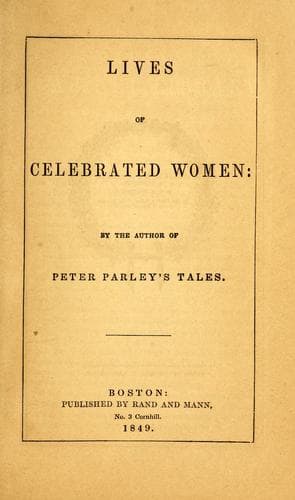
Lives of Celebrated WomenGoodrich, Samuel G. (Samuel Griswold)
History
Lives of Celebrated Women
Goodrich, Samuel G. (Samuel Griswold)
Women -- Biography
Lady Hester believed in the science of astrology to the fullest
extent. She believed that we are all children of some one of the
celestial fires which presided at our birth, and of which the happy or
malignant influence is written in our eyes, on our foreheads, in our
fortunes, in the lines of our hands, in the form of our feet, in our
gesture, in our walk. She believed that, from these various elements,
she could read the character and destiny of any individual who was but
for a few moments in her presence. In accordance with her belief, she
thought that skilful astrologers should be appointed to every
district, to consult the heavenly bodies at the birth of every child;
the nature of each natal star to be registered by them, and kept
secret till the period of education, which is to be adapted to that
particular calling which the star of every human being indicates.
The following somewhat poetical description of the personal appearance
of Lady Hester is given by a traveller, who, in 1832, was suffered to
visit her--a favor rarely granted to Europeans: "I was introduced into
her cabinet by a little negro child. It was so extremely dark, that it
was with difficulty I could distinguish her noble, grave, yet mild and
majestic features, clad in an Oriental costume. She rose from the
divan, advanced, and offered me her hand. She appeared to be about
fifty years of age; but she possessed those personal traits which
years cannot alter. Freshness, color, and grace, depart with youth;
but when beauty resides in the form itself, in purity of expression,
in dignity, in majesty, and a thoughtful countenance, whether in man
or woman, this beauty may change with the different periods of life,
but it does not pass away--it eminently characterized the person of
Lady Hester Stanhope.
"She wore a white turban, and on her forehead was a purple-colored
woollen fillet, which fell on each side of her head as low as her
shoulders. A long, yellow Cashmere shawl, and an immense Turkish robe
of white silk, with flowing sleeves, enveloped all her person in
simple and majestic folds, while an opening of these folds upon the
bosom displayed a tunic of rich Persian stuff, covered with flowers,
which was attached round the neck by a clasp of pearls. Turkish yellow
morocco boots, embroidered with silk, completed this beautiful
Oriental costume, which she wore with that freedom and grace, as if
she had never used any other from her youth."
Public-domain text, read in full here on John Shaqi.
Reviews
Reviews
No reviews yet
Be the first to share your thoughts on this work.
Elsewhere in the archive
Join the Discussion
Join the discussion
Sign in to leave a comment or review.
Sign InorCreate an account