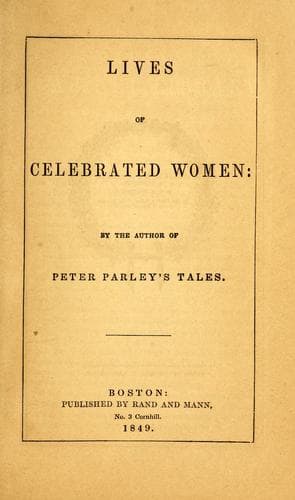
Lives of Celebrated WomenGoodrich, Samuel G. (Samuel Griswold)
History
Lives of Celebrated Women
Goodrich, Samuel G. (Samuel Griswold)
Women -- Biography
Though Lady Hester retained her power over the lower classes by means
of their superstitious fears, the neighboring chiefs were not to be
thus restrained, and some of them sought by robbery to indemnify
themselves for the loss of the accustomed presents. Hoping to coerce
her into a renewal of them, they harassed her by petty vexations; her
camels were seized; her servants were beaten; and at length, when she
retaliated, a firman was procured, forbidding any Mussulman, on pain
of death, to remain in her service, or to carry water to her house.
The severity of the last prohibition may be judged from the fact that
the water for the use of her house and garden had to be brought from a
river three or four miles distant. Her appeal, however, to the Porte
procured the withdrawal of the firman, and saved her gardens from the
destruction which a want of irrigation would soon have produced.
In 1837, a new source of vexation to Lady Hester arose. The British
government, having received information that some of her English
creditors were in a state of destitution, appropriated the pension
which Lady Hester had so long received to their relief. This met with
a spirited remonstrance on the part of her ladyship, who called to
her aid the Duke of Wellington and other opponents of the whig
administration. Failing in these efforts, she appealed to the queen
herself, but with no better success. She did not long survive this
new source of mortification. On hearing of her illness, the British
consul at Beyroot, accompanied by Mr. Thomson, an American missionary,
hastened to her assistance; but, on their arrival, nothing was left
for them to do but to pay the last sad offices to her remains. She
died on the 23d of June, 1839.
Various and opposing motives have been assigned for the unusual
conduct of Lady Hester: we think, however, its explanation is to be
found in an eccentric imagination, a turn for adventure, and that love
of power which is inherent in the human breast. We can hardly consider
it more extraordinary that one English lady should be found willing to
accept a government under the sunny skies of Syria, than that so many
English officers should seek for sway on the burning shores of Africa
and the East Indies.
HANNAH MORE.
Hannah More was the youngest but one of the five daughters of Jacob
More, who, after receiving an education for the church, bounded his
wishes by the possession of a school at Stapleton, England, upon
obtaining which, he married the daughter of a respectable farmer; and
to the soundness of her judgment in the culture and regulation of her
children, the credit and success which attended them are, in a great
degree, to be attributed.
Public-domain text, read in full here on John Shaqi.
Reviews
Reviews
No reviews yet
Be the first to share your thoughts on this work.
Elsewhere in the archive
Join the Discussion
Join the discussion
Sign in to leave a comment or review.
Sign InorCreate an account