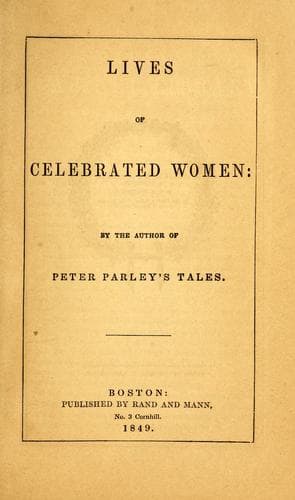
Lives of Celebrated WomenGoodrich, Samuel G. (Samuel Griswold)
History
Lives of Celebrated Women
Goodrich, Samuel G. (Samuel Griswold)
Women -- Biography
Like other intelligent children, Hannah More displayed at an early age
a desire for knowledge and a love of books. To supply the want of the
latter, her father was accustomed to relate to his children, from
memory, the most striking events of Grecian and Roman history,
dwelling much on the parallels and wise sayings of Plutarch. He would
also recite to them the speeches of his favorite heroes in the
original languages, and then translate them into English. Hannah thus
acquired a taste for the Latin classics, an acquaintance with which
she carefully cultivated, in defiance of her father's horror of _blue
stockingism_, which was extreme, and which probably prevented his
instructing her in Greek.
The bent of her mind displayed itself at an early age. Every scrap of
paper, of which she could possess herself, was scribbled over with
essays and poems, having some well-directed moral. Her little sister,
with whom she slept, was the depositary of her nightly effusions; and,
in her zeal lest they should be lost, she would sometimes steal down
to procure a light, and commit them to paper. The greatest wish her
imagination could frame, was that she might some day be rich enough to
have a whole quire of paper; and, when this wish was gratified, she
soon filled it with letters to depraved characters, of her own
invention, urging them to abandon their errors, and letters in return,
expressive of contrition and resolutions of amendment.
[Illustration: HANNAH MORE.]
Her elder sisters, having been educated with that view, opened a
boarding-school for young ladies at Bristol; and under their care the
school education of Hannah was completed. While yet a pupil, she
attracted the notice and enjoyed the friendship of many eminent men.
She delighted to study the sciences with Ferguson, the astronomer; and
such was his opinion of her taste and genius, that he submitted his
compositions to her for the correction of errors in style. Of her
conversational powers at this period an anecdote is related. A
dangerous illness brought her under the care of Dr. Woodward, an
eminent physician. On one of his visits, being led into conversation
with his patient on literary subjects, he forgot the purpose of his
coming; till, recollecting himself when half way down stairs, he cried
out, "Bless me! I forgot to ask the girl how she was;" and returned to
the room, exclaiming, "How are you to-day, my poor child?"
Public-domain text, read in full here on John Shaqi.
Reviews
Reviews
No reviews yet
Be the first to share your thoughts on this work.
Elsewhere in the archive
Join the Discussion
Join the discussion
Sign in to leave a comment or review.
Sign InorCreate an account