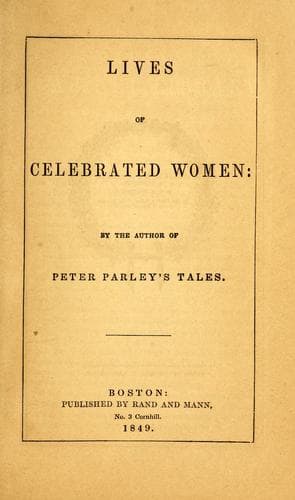
Lives of Celebrated WomenGoodrich, Samuel G. (Samuel Griswold)
History
Lives of Celebrated Women
Goodrich, Samuel G. (Samuel Griswold)
Women -- Biography
The success of "Percy" was prodigious; greater than that of any
tragedy for years. She received for it about six hundred pounds,
which, she tells us, "her friend Mr. Garrick invested for her on
the best security, and at five per cent., and so it made a decent
little addition to her small income." Cadell paid one hundred and
fifty pounds for the copy-right, and it proved a very successful
speculation. The first edition, of four thousand copies,--a very
large one for those days,--was sold off in a fortnight.
Though the patronage of Garrick and the popularity of the author
contributed in no small degree to its success, yet the tragedy
itself possesses intrinsic merits. The plot is simple. Bertha, the
daughter of Lord Raby, is betrothed, in early youth, to Earl Percy.
His family incur the displeasure of Lord Raby, and, during the young
earl's absence in the Holy Land, he compels his daughter to marry
Earl Douglas, the hereditary enemy of the Percys. The proud spirit
of Douglas is chafed to find that his own ardent love is met only
with cold and respectful obedience. He suspects the preengagement
of her affections, and his jealousy rouses him to fury, when Percy
is found in the neighborhood of his castle. In the catastrophe,
all the principal personages are involved in a common destruction.
In the development of the plot the author displays considerable
imagination, and much dramatic skill. The interest is well sustained;
the didactic spirit sometimes breaks forth, as in the conclusion of
the following extract, in which Lord Raby laments the sombre and
melancholy spirit with which the jealousy of Douglas has infected his
whole household:--
"----Am I in Raby castle?
Impossible! That was the seat of smiles;
There cheerfulness and joy were household gods.
But now suspicion and distrust preside,
And discontent maintains a sullen sway.
Where is the smile unfeigned, the jovial welcome,
Which cheered the sad, beguiled the pilgrim's pain,
And made dependency forget its bonds?
Where is the ancient, hospitable hall,
Whose vaulted roof once rung with harmless mirth;
Where every passing stranger was a guest,
And every guest a friend? I fear me much,
If once our nobles scorn their rural seats,
Their rural greatness, and their vassals' love,
Freedom and English grandeur are no more."
The following passage, in which Bertha seeks to exculpate herself for
the breach of faith with which Percy, whom she meets by accident after
his return, charges her, is full of pathos:--
"I could withstand his fury; but his tears--
Ah, they undid me! Percy, dost thou know
The cruel tyranny of tenderness?
Hast thou e'er felt a father's warm embrace?
Hast thou e'er seen a father's flowing tears,
And known that thou couldst wipe those tears away?
If thou hast felt, and hast resisted these,
Then thou may'st curse my weakness; but if not,
Thou canst not pity, for thou canst not judge."
Public-domain text, read in full here on John Shaqi.
Reviews
Reviews
No reviews yet
Be the first to share your thoughts on this work.
Elsewhere in the archive
Join the Discussion
Join the discussion
Sign in to leave a comment or review.
Sign InorCreate an account