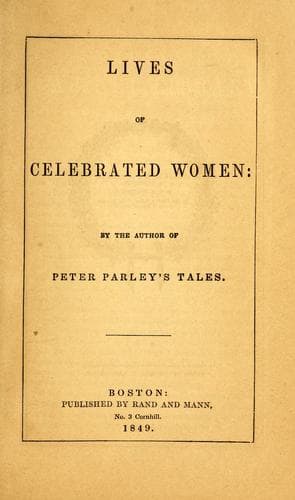
Lives of Celebrated WomenGoodrich, Samuel G. (Samuel Griswold)
History
Lives of Celebrated Women
Goodrich, Samuel G. (Samuel Griswold)
Women -- Biography
Encouraged by the success of "Percy," and urged by Garrick, Miss More
composed a second tragedy, called the "Fatal Falsehood." The whole was
completed, and four acts had been revised by Garrick, when death
deprived her of that warm and disinterested friend. Miss More pays the
following tribute to his memory: "I never can cease to remember with
affection and gratitude so warm, steady, and disinterested a friend; I
can most truly bear this testimony to his memory, that I never
witnessed, in any family, more decorum, propriety, and regularity,
than in his; where I never saw a card, or ever met--except in one
instance--a person of his own profession at his table. All his
pursuits and tastes were so decidedly intellectual, that it made the
society and the conversation which was always to be found in his
circle, interesting and delightful."
The success of the "Fatal Falsehood" was great, but not equal to that
of "Percy." We must content ourselves with making one extract, in
which she characterizes "Honor," as it is technically called:--
"Honor! O yes, I know him. 'Tis a phantom,
A shadowy figure, wanting bulk and life,
Who, having nothing solid in himself,
Wraps his thin form in Virtue's plundered robe,
And steals her title. Honor! 'tis the fiend
Who feeds on orphans' tears and widows' groans,
And slakes his impious thirst in brothers' blood.
Honor! why, 'tis the primal law of hell!
The grand device to people the dark realms
With noble spirits, who, but for this cursed honor,
Had been at peace on earth, or blessed in heaven.
With this _false_ honor Christians have no commerce;
Religion disavows, and truth disowns it."
One more tragedy, the "Inflexible Captive," completes Miss More's
labors in this department of literature. She arrived at the conclusion
that, by contributing plays, however pure, to the existing stage, she
should be using her powers to heighten its _general_ attraction as a
place of amusement; and, considering the English theatre as, on the
whole, the most profligate in the world, she resolved to abjure it and
all its concerns forever--an instance of self-love sacrificed to
principle hardly to be paralleled. When her works were collected, the
tragedies were allowed to take their place, in order, as the author
tells us in a preface written in her happiest manner, that she might
ground on such publication her sentiments upon the general tendency of
the drama, and, by including in her view her own compositions, might
involve herself in the general object of her own animadversions.
She makes no apology for the republication of her "Sacred Dramas,"
though they may, perhaps, be regarded as falling within the range of
some of her criticisms on the old Mysteries and Moralities--pieces "in
which events too solemn for exhibition, and subjects too awful for
detail, are brought before the audience with a formal gravity more
offensive than levity itself."
Public-domain text, read in full here on John Shaqi.
Reviews
Reviews
No reviews yet
Be the first to share your thoughts on this work.
Elsewhere in the archive
Join the Discussion
Join the discussion
Sign in to leave a comment or review.
Sign InorCreate an account