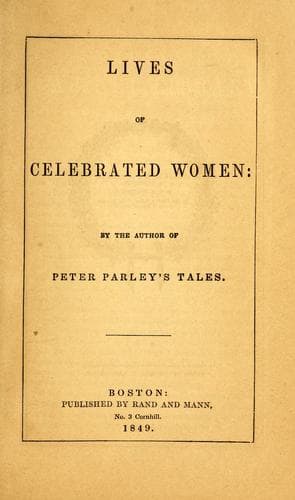
Lives of Celebrated WomenGoodrich, Samuel G. (Samuel Griswold)
History
Lives of Celebrated Women
Goodrich, Samuel G. (Samuel Griswold)
Women -- Biography
As a general poet, Miss More was, at this period, the very height of
the fashion. Horace Walpole thought himself honored in being
permitted to print some of her pieces in the most lavish style of
expense, at the press of Strawberry Hill. But fashions in literature
are scarcely more lasting than those in dress. Her poems are now
immersed in Lethe, except a few terse couplets, which have floated
down to the present generation on the stream of oral citation, and
are now often in the mouths of people who fancy that they belong
to Swift or Gay. Many of her poems are, however, worthy of a better
fate. They are distinguished by purity and elevation of sentiment,
ease and strength of diction, and harmony of versification. In the
last particular she received great praise from Johnson, who
pronounced her to be "the best versificatrix in the English
language."
We will give a few extracts. The first is from "Sensibility," a poem
in which she claims for that quality the place which Mrs. Grenville,
in a then well-known ode, arrogated for "Indifference."
"Sweet sensibility! thou keen delight!
Unprompted moral! sudden sense of right!
Perception exquisite! fair virtue's seed!
Thou quick precursor of the liberal deed!
Thou hasty conscience! reason's blushing morn!
Instinctive kindness e'er reflection's born!
Prompt sense of equity! to thee belongs
The swift redress of unexamined wrongs;
Eager to serve, the cause perhaps untried,
But always apt to choose the suffering side;
To those who know thee not no words can paint,
And those who know thee know all words are faint.
She does not feel thy power who boasts thy flame,
And rounds her every period with thy name.
As words are but th' external marks to tell
The fair ideas in the mind that dwell,
And only are of things the outward sign,
And not the things themselves they but define,
So exclamations, tender tones, fond tears,
And all the graceful drapery feeling wears,--
These are her garb, not her; they but express
Her form, her semblance, her appropriate dress;
And these fair marks,--reluctant I relate,--
These lovely symbols, may be counterfeit.
There are who fill with brilliant plaints the page,
If a poor linnet meet the gunner's rage;
There are who for a dying fawn deplore,
As if friend, parent, country, were no more;
Who boast, quick rapture trembling in their eye,
If from a spider's snare they snatch a fly;
There are whose well-sung plaints each breast inflame,
And break all hearts--but his from whence they came."
Public-domain text, read in full here on John Shaqi.
Reviews
Reviews
No reviews yet
Be the first to share your thoughts on this work.
Elsewhere in the archive
Join the Discussion
Join the discussion
Sign in to leave a comment or review.
Sign InorCreate an account