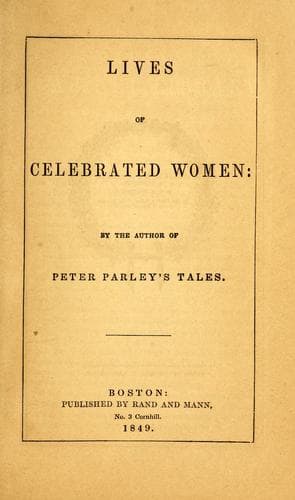
Lives of Celebrated WomenGoodrich, Samuel G. (Samuel Griswold)
History
Lives of Celebrated Women
Goodrich, Samuel G. (Samuel Griswold)
Women -- Biography
That Miss More's efforts in behalf of virtue should be opposed by
those against whom they were aimed, will not surprise us. But she
was attacked from a quarter whence she had a right to expect sympathy
and support. The nature of the attack will be learned from a letter
written some years afterwards: "I will say, in a few words, that
two Jacobin and infidel curates, poor and ambitious, formed the
design of attracting notice and getting preferment by attacking some
charity schools--which, with no small labor, I have carried on in
this country for near twenty years--as seminaries of vice, sedition,
and disaffection. At this distance of time,--for it is now ended in
their disgrace and shame,--it will make you smile when I tell you a
few of the charges brought against me, viz., that I hired two men
to assassinate one of these clergymen; that I was actually taken
up for seditious practices; that I was with Hadfield in his attack
on the king's life. At the same time they declared--mark the
consistency--that I was in the pay of the government, and the grand
instigator of the war, by my mischievous pamphlets. That wicked men
should invent this, is not so strange as that they should have found
magazines, reviews, and pamphleteers, to support them. My declared
resolution never to defend myself certainly encouraged them to go on.
How thankful am I that I kept that resolution! though the grief and
astonishment excited by the combination against me nearly cost me my
life."
There is not space to go at large into an account of this persecution,
which was continued for several years. The most inveterate of her
enemies was the curate of her own parish, who was named Bere, and the
most distressing result to herself was being obliged to discontinue
the school at that place. But, whilst laboring so earnestly for the
poor and the humble, Miss More was still mindful of the wants of the
higher classes, and, in the midst of her anxiety and distress, which
very seriously affected her health, she found time to compose the
"Strictures on Female Education," for their benefit. All her practical
admonitions, and all her delineations of female excellence, were
afterwards brought together in the character of Lucilla, in the novel
of "Coelebs in Search of a Wife," who is a true representative of
feminine excellence within the legitimate range of allotted duties.
She did not venture on publishing this work without much anxious
hesitation. "I wrote it," she says, "to amuse the languor of disease.
I thought there were already good books enough in the world for good
people, but that there was a large class of readers, whose wants had
not been attended to--the subscribers to the circulating library. A
little to raise the tone of that mart of mischief, and to counteract
its corruptions, I thought an object worth attempting." It was
published without her name, and though many at once recognized the
style, she herself did not acknowledge it till it had passed through
many editions.
Public-domain text, read in full here on John Shaqi.
Reviews
Reviews
No reviews yet
Be the first to share your thoughts on this work.
Elsewhere in the archive
Join the Discussion
Join the discussion
Sign in to leave a comment or review.
Sign InorCreate an account