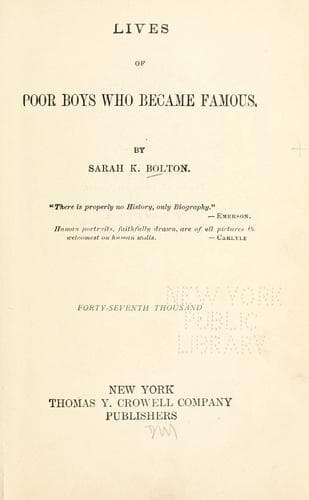
Lives of Poor Boys Who Became FamousBolton, Sarah Knowles
History
Lives of Poor Boys Who Became Famous
Bolton, Sarah Knowles
Biography
To Richter this was a death-blow. He went on writing, while the tears
dropped upon his page. He could never bear the sight of a book his boy
had touched, and the word "philology," his son's favorite study, cut him
to the heart. At the end of three months he wrote to a friend, "My being
has suffered not merely a wound, but a complete cutting off of all joy.
My longing after him grows always more painful." Broken in health he
visited Dresden; but the end was near. The sight of the left eye at
first failed him, then the right, till he was left in complete darkness.
He still hoped to finish his autobiography, and the "Immortality of the
Soul," begun on the very day Max was buried; but this was denied him.
Once only did his sorrows overpower him, when pitifully looking toward
the window, he cried out as Ajax in the "Iliad":--
"Light! light only, then may the enemy come!"
The devoted wife and two daughters grew unspeakably dear to him. When
tired with thinking, he would seat himself at the piano, and play till
he, as well as those who heard him, would burst into tears. On the 14th
of November, 1825, he sat in his chamber, his youngest child climbing on
the back of his chair, and laying her face against her father's. It was
only noon, but thinking it was night, Richter said, "It is time to go to
rest." He was wheeled into his sleeping apartment, and some flowers laid
on the bed beside him. "My beautiful flowers! My lovely flowers!" he
said, as he folded his arms, and soon fell asleep. His wife sat beside
him, her eyes fixed on the face of the man she loved. About six the
doctor arrived. The breath came shorter, the face took on a heavenly
expression, and grew cold as marble. The end had come. He was buried by
torchlight, the unfinished manuscript of the "Immortality of the Soul"
being borne upon his coffin, while the students sung Klopstock's hymn,
"Thou shalt arise, my Soul." His more than one hundred volumes and his
noble, generous life are his monuments. He said, "I shall die without
having seen Switzerland or the ocean, but the ocean of eternity I shall
not fail to see."
LEON GAMBETTA.
On January 6, 1883, Paris presented a sad and imposing spectacle. Her
shops were closed; her public buildings and her homes were draped in
black. Her streets were solid with hundreds of thousands, all
dispirited, and many in tears. A large catafalque covered with black
velvet upheld a coffin shrouded with the tricolor. From a vase at each
corner rose burning perfume, whose vapor was like sweet incense. Six
black horses drew the funeral car, and two hundred thousand persons
followed in the procession, many bearing aloft wreaths of flowers, and
shouting, "Vive la Republique! Vive la Gambetta!"
Public-domain text, read in full here on John Shaqi.
Reviews
Reviews
No reviews yet
Be the first to share your thoughts on this work.
Elsewhere in the archive
Join the Discussion
Join the discussion
Sign in to leave a comment or review.
Sign InorCreate an account