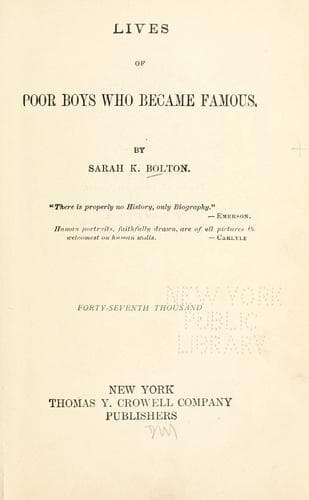
Lives of Poor Boys Who Became FamousBolton, Sarah Knowles
History
Lives of Poor Boys Who Became Famous
Bolton, Sarah Knowles
Biography
The maker of the Republic, the brilliant, eloquent leader of the French
people, was dead; dead in the prime of his life at forty-five. The
"Figaro" but voiced the feeling of the world when it said, "The Republic
has lost its greatest man." America might well mourn him as a friend,
for he made her his pattern for his beloved France. The "Pall-Mall
Gazette" said, "He will live in French history among the most
courageous"; and even Germany courted him as the bravest of the brave,
while she breathed freer, saying in the "Berlin Press," "The death of
Gambetta delivers the peace of Europe from great danger." The hand that
would sometime doubtless have reached out to take back sobbing Alsace
and Lorraine was palsied; the voice that swayed the multitude, now with
its sweet persuasiveness, and now with its thunder like the rush of a
swollen torrent, was hushed; the supreme will that held France like a
willing child in its power, had yielded to the inevitable,--death.
[Illustration: LEON GAMBETTA.]
Leon Gambetta was born at Cahors, April 2, 1838. His father was an
Italian from Genoa, poor, and of good character; his mother, a French
woman, singularly hopeful, energetic, and noble. They owned a little
bazaar and grocery, and here, Onasie, the wife, day after day helped her
husband to earn a comfortable living. When their only son was seven
years old, he was sent to a Jesuits' preparatory school at Monfaucon,
his parents hoping that he would become a priest. His mother had great
pride in him, and faith in his future. She taught him how to read from
the "National," a newspaper founded by Thiers, republican in its
tendencies. She saw with delight that when very young he would learn the
speeches of Thiers and Guizot, which he found in its columns, and
declaim them as he roamed alone the narrow streets, and by the quaint
old bridges and towers of Cahors. At Monfaucon, he gave his orations
before the other children, the mother sending him the much-prized
"National" whenever he obtained good marks, and the Jesuits, whether
pleased or not, did not interfere with their boyish republican.
At eight years of age an unfortunate accident happened which bade fair
to ruin his hopes. While watching a cutter drill the handle of a knife,
the foil broke, and a piece entered the right eye, spoiling the sight.
Twenty years afterward, when the left, through sympathy, seemed to be
nearly destroyed, a glass eye was inserted, and the remaining one was
saved.
Public-domain text, read in full here on John Shaqi.
Reviews
Reviews
No reviews yet
Be the first to share your thoughts on this work.
Elsewhere in the archive
Join the Discussion
Join the discussion
Sign in to leave a comment or review.
Sign InorCreate an account