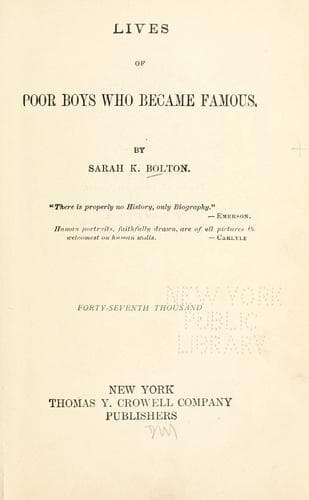
Lives of Poor Boys Who Became FamousBolton, Sarah Knowles
History
Lives of Poor Boys Who Became Famous
Bolton, Sarah Knowles
Biography
When Leon was ten years old, the Revolution of 1848 deposed Louis
Philippe, the Orleanist, and Louis Napoleon was made President of the
Republic. Perhaps the people ought to have known that no presidency
would long satisfy the ambition of a Bonaparte. He at once began to
increase his power by winning the Catholic Church to his side. The
Jesuits no longer allowed the boy Leon to talk republicanism; they saw
that it was doomed. They scolded him, whipped him, took away the
"National," and finally expelled him, writing to his parents, "You will
never make a priest of him; he has an utterly undisciplinable
character."
The father frowned when he returned home, and the neighbors prophesied
that he would end his life in the Bastile for holding such radical
opinions. The poor mother blamed herself for putting the "National" into
his hands, and thus bringing all this trouble upon him. Ah, she wrought
better than she knew! But for the "National," and Gambetta's
unconquerable love for a republic, France might to-day be the plaything
of an emperor.
Meantime Louis Napoleon was putting his friends into office, making
tours about the country to win adherents, and securing the army and the
police to his side. At seven o'clock, on the morning of December 2,
1851, the famous Coup d'etat came, and the unscrupulous President had
made himself Emperor. Nearly two hundred and fifty deputies were
arrested and imprisoned, and the Republicans who opposed the usurpation
were quickly subdued by the army. Then the French were graciously
permitted to say, by ballot, whether they were willing to accept the
empire. There was, of course, but one judicious way to vote, and that
was in the affirmative, and they thus voted.
Joseph Gambetta, the father, saw the political storm which was coming,
and fearing for his outspoken son, locked him up in a lyceum at Cahors,
till he was seventeen. Here he attracted the notice of his teachers by
his fondness for reading, his great memory, and his love of history and
politics. At sixteen he had read the Latin authors, and the economical
works of Proudhon. When he came home, his father told him that he must
now become a grocer, and succeed to the business. He obeyed, but his
studious mind had no interest in the work. He recoiled from spending his
powers in persuading the mayor's wife that a yard of Genoa velvet at
twenty francs was cheaper than the same measure of the Lyon's article at
thirteen. So tired and sick of the business did he become, that he
begged his father to be allowed to keep the accounts, which he did in a
neat, delicate hand.
His watchful mother saw that her boy's health was failing. He was
restless and miserable. He longed to go to Paris to study law, and then
teach in some provincial town. He planned ways of escape from the hated
tasks, but he had no money, and no friends in the great city.
Public-domain text, read in full here on John Shaqi.
Reviews
Reviews
No reviews yet
Be the first to share your thoughts on this work.
Elsewhere in the archive
Join the Discussion
Join the discussion
Sign in to leave a comment or review.
Sign InorCreate an account