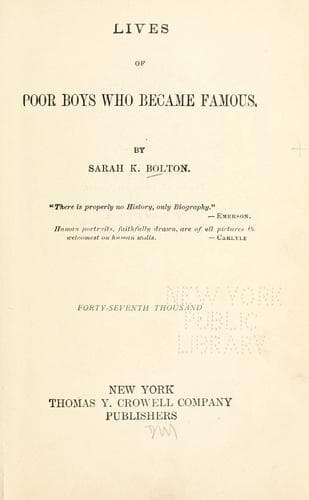
Lives of Poor Boys Who Became FamousBolton, Sarah Knowles
History
Lives of Poor Boys Who Became Famous
Bolton, Sarah Knowles
Biography
Finally his hour came. At the Coup d'etat, Dr. Baudin, a deputy, for
defending the rights of the National Assembly, was shot on a barricade.
On All-Soul's Day, 1868, the Republicans, to the number of a thousand,
gathered at the grave in the cemetery of Montmartre, to lay flowers upon
it and listen to addresses. The Emperor could not but see that such
demonstrations would do harm to his throne. Dellschuzes, the leader, was
therefore arrested, and chose the unknown lawyer, Gambetta, to defend
him. He was a strong radical, and he asked only one favor of his lawyer,
that he would "hit hard the Man of December," as those who hated the
Coup d'etat of December 2, loved to call Louis Napoleon.
Gambetta was equal to the occasion. He likened the Emperor to Catiline,
declaring that as a highwayman, he had taken France and felled her
senseless. "For seventeen years," he said, "you have been masters of
France, and you have never dared to celebrate the Second of December. It
is we who take up the anniversary, which you no more dare face than a
fear-haunted murderer can his victim's corpse." When finally, overcome
with emotion, Gambetta sank into his seat at the close of his speech,
the die was cast. He had become famous from one end of France to the
other, and the Empire had received a blow from which it never recovered.
That night at the clubs, and in the press offices, the name of Leon
Gambetta was on every lip.
It is not strange that in the elections of the following year, he was
asked to represent Belleville and Marseilles, and chose the latter,
saying to his constituents that he was in "irreconcilable opposition to
the Empire." He at once became the leader of a new party, the
"Irreconcilables," and Napoleon's downfall became from that hour only a
question of time. Gambetta spoke everywhere, and was soon conceded to be
the finest orator in France. Worn in body, by the confinement of the
secretaryship, and the political campaign, he repaired to Ems for a
short time, where he met Bismarck. "He will go far," said the Man of
Iron. "I pity the Emperor for having such an irreconcilable enemy." The
"National," under Madam Gambetta's teaching in childhood, was bearing
fruit.
Napoleon saw that something must be done to make his throne more stable
in the hearts of his people. He attempted a more liberal policy, with
Emile Ollivier at the head of affairs. But Gambetta was still
irreconcilable, saying in one of his great speeches, "We accept you and
your Constitutionalism as a bridge to the Republic, but nothing more."
At last war was declared against Prussia, as much with the hope of
promoting peace at home as to win honors in Germany. Everybody knows the
rapid and crushing defeat of the French, and the fall of Napoleon at
Sedan, September 2, when he wrote to King William of Prussia, "Not
having been able to die at the head of my troops, I can only resign my
sword into the hands of your Majesty."
Public-domain text, read in full here on John Shaqi.
Reviews
Reviews
No reviews yet
Be the first to share your thoughts on this work.
Elsewhere in the archive
Join the Discussion
Join the discussion
Sign in to leave a comment or review.
Sign InorCreate an account