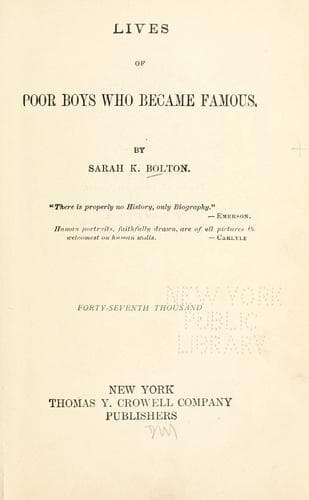
Lives of Poor Boys Who Became FamousBolton, Sarah Knowles
History
Lives of Poor Boys Who Became Famous
Bolton, Sarah Knowles
Biography
When the news reached Paris on the following day, the people were
frantic. Had the Emperor returned, a defeated man, he could never have
reached the Tuileries alive. Crowds gathered in the streets, and forced
their way into the hall of the Corps Legislatif. Then the eloquent
leader of the Republican ranks, scarcely heard of two years before,
ascended the Tribune, and declared that, "Louis Napoleon Bonaparte and
his dynasty have forever ceased to reign over France." With Jules Favre,
Ferry, Simon, and others, he hastened to the Hotel de Ville, writing on
slips of paper, and throwing out to the multitude, the names of those
who were to be the heads of the provisional government. Cool, fearless,
heroic, Gambetta stood at the summit of power, and controlled the
people. They believed in him because he believed in the Republic.
Meantime the German armies were marching on Paris. The people fortified
their city, and prepared to die if need be, in their homes. Before Paris
was cut off from the outside world by the siege, part of the governing
force retired to Tours. It became necessary for Gambetta, in October, to
visit this city for conference, and to accomplish this he started in a
balloon, which was just grazed by the Prussian guns as he passed over
the lines. It was a hazardous step; but the balloon landed in a forest
near Amiens, and he was safe. When he arrived in Tours there was not a
soldier in the place; in a month, by superhuman energy, and the most
consummate skill and wisdom, he had raised three armies of eight
hundred thousand men, provided by loan for their maintenance, and
directed their military operations. One of the prominent officers on the
German side says, "This colossal energy is the most remarkable event of
modern history, and will carry down Gambetta's name to remote
posterity."
He was now in reality the Dictator of France, at thirty-two years of
age. He gave the fullest liberty to the press, had a pleasant "Bon jour,
mon ami" for a workman, no matter how overwhelmed with cares he might
be, and a self-possession, a quickness of decision, and an indomitable
will that made him a master in every company and on every occasion. He
electrified France by his speeches; he renewed her courage, and revived
her patriotism. Even after the bloody defeat of Bazaine at Gravelotte,
and his strange surrender of one hundred and seventy thousand men at
Metz, Gambetta did not despair of France being able, at least, to demand
an honorable peace.
But France had grown tired of battles. Paris had endured a siege of four
months, and the people were nearly in a starving condition. The
Communists, too, were demanding impossible things. Therefore, after
seven months of war, the articles of peace were agreed upon, by which
France gave to Germany fourteen hundred million dollars, to be paid in
three years, and ceded to her the provinces of Alsace and Lorraine.
Public-domain text, read in full here on John Shaqi.
Reviews
Reviews
No reviews yet
Be the first to share your thoughts on this work.
Elsewhere in the archive
Join the Discussion
Join the discussion
Sign in to leave a comment or review.
Sign InorCreate an account