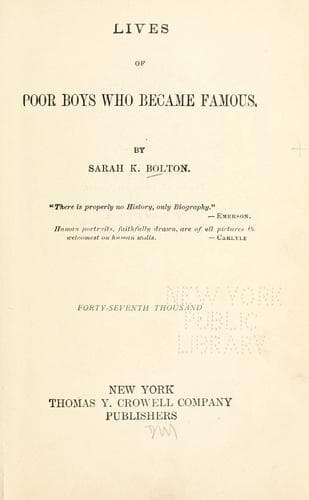
Lives of Poor Boys Who Became FamousBolton, Sarah Knowles
History
Lives of Poor Boys Who Became Famous
Bolton, Sarah Knowles
Biography
Gambetta could never bring himself to consent to these humiliating
conditions, and on the day on which the terms were ratified, he and his
colleagues from these two sections of the country, left the assembly
together. Just as they were passing out, the venerable Jean Kuss, mayor
of Strasburg, staggered up to Gambetta, saying, "Let me grasp your
patriot's hand. It is the last time I shall shake it. My heart is
broken. Promise to redeem brave Strasburg." He fell to the floor, and
died almost immediately. Gambetta retired to Spain, till recalled by the
elections of the following July.
He now began again his heroic labors, speaking all through France,
teaching the people the true principles of a republic; not communism,
not lawlessness, but order, prudence, and self-government. He urged
free, obligatory education, and the scattering of books, libraries, and
institutes everywhere. When Thiers was made the first President,
Gambetta was his most important and truest ally, though the former had
called him "a furious fool"; so ready was the Great Republican to
forgive harshness.
In 1877 he again saved his beloved Republic. The Monarchists had become
restless, and finally displaced Thiers by Marshal MacMahon, a strong
Romanist, and a man devoted to the Empire. It seemed evident that
another coup d'etat was meditated. Gambetta stirred the country to
action. He declared that the President must "submit or resign," and for
those words he was sentenced to three months' imprisonment and a fine of
four hundred dollars, which sentence was never executed. MacMahon seeing
that the Republic was stronger than he had supposed, soon after resigned
his position, and was succeeded by M. Grevy. Gambetta was made President
of the Assembly, and doubtless, if he had lived, would have been made
President of the Republic.
There were not wanting those who claimed that he was ambitious for the
supreme rule; but when death came from the accidental discharge of a
pistol, producing a wound in the hand, all calumny was hushed, and
France beheld her idol in his true light,--the incarnation of
republicanism. Two hours before his death, at his plain home just out of
Paris at Ville d'Avray, he said, "I am dying; there is no use in denying
it; but I have suffered so much it will be a great deliverance." He
longed to last till the New Year, but died five minutes before midnight,
Dec. 31, 1882. The following day, fifteen thousand persons called to see
the great statesman as he lay upon his single iron bedstead.
Public-domain text, read in full here on John Shaqi.
Reviews
Reviews
No reviews yet
Be the first to share your thoughts on this work.
Elsewhere in the archive
Join the Discussion
Join the discussion
Sign in to leave a comment or review.
Sign InorCreate an account