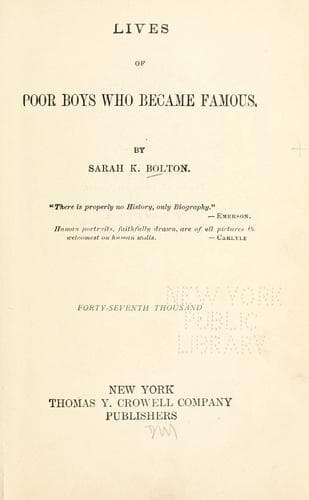
Lives of Poor Boys Who Became FamousBolton, Sarah Knowles
History
Lives of Poor Boys Who Became Famous
Bolton, Sarah Knowles
Biography
He soon purchased a few acres of land near the mill, and erected a
simple home for his bride. Here they lived for twenty years, and here
their nine children were born, four of whom died early. It was happiness
to go daily to his work, receive his comfortable salary, and see his
children grow up around him with their needed wants supplied. But the
comfortable salary came to an end. Colonel Beebe withdrew from active
business, the mill was turned into a woollen factory, and Cornell was
thrown out of work. Business depression was great all over the country.
In vain for months he sought for employment. The helpless family must be
supported; at the age of thirty-six matters began to look serious.
Finally, he went to Maine in the endeavor to sell the patent right of a
new plow, recently invented. He visited the "Maine Farmer," and met the
editor, Hon. F. O. J. Smith, a member of Congress, who became much
interested. He tried also to sell the patent in the State of Georgia,
walking usually forty miles a day, but with little success. Again he
started for Maine, walking from Ithaca to Albany, one hundred and sixty
miles in four days, then, going by rail to Boston, and once more on foot
to Portland. He was fond of walking, and used to say, "Nature can in no
way be so rationally enjoyed, as through the opportunities afforded the
pedestrian."
Entering the office of the "Maine Farmer" again, he found "Mr. Smith on
his knees in the middle of his office floor, with a piece of chalk in
his hand, the mould-board of a plow lying by his side, and with various
chalk-marks on the floor before him."
Mr. Smith arose and grasped him cordially by the hand, saying, "Cornell,
you are the very man I want to see. I have been trying to explain to
neighbor Robertson a machine that I want made, but I cannot make him
understand it. I want a kind of scraper, or machine for digging a ditch
for laying our telegraph pipe under ground. Congress has appropriated
thirty thousand dollars to enable Professor Morse to test the
practicability of his telegraph on a line between Washington and
Baltimore. I have taken the contract to lay the pipe at one hundred
dollars a mile."
Mr. Cornell's ready brain soon saw what kind of a machine was needed,
and he sketched a rough diagram of it.
Without much hope of success, Smith said, "You make a machine, and I
will pay the expense whether successful or not; if successful, I will
pay you fifty dollars, or one hundred, or any price you may name."
Public-domain text, read in full here on John Shaqi.
Reviews
Reviews
No reviews yet
Be the first to share your thoughts on this work.
Elsewhere in the archive
Join the Discussion
Join the discussion
Sign in to leave a comment or review.
Sign InorCreate an account