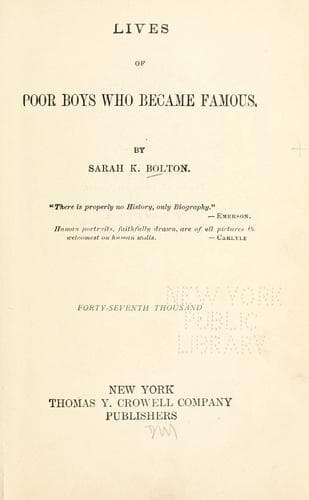
Lives of Poor Boys Who Became FamousBolton, Sarah Knowles
History
Lives of Poor Boys Who Became Famous
Bolton, Sarah Knowles
Biography
Mr. Cornell at once went to a machine shop, made the patterns for the
necessary castings, and then the wood-work for the frame. The trial of
the new machine was made at Mr. Smith's homestead, four yoke of oxen
being attached to the strange-looking plow, which cut a furrow two and
one-half feet deep, and one and one-fourth inches wide, and laid the
pipe in the bottom at the same time. It worked successfully, and Mr.
Cornell was asked to take charge of the laying of the pipe between
Baltimore and Washington. He accepted, for he believed the telegraph
would become a vast instrument in civilization. The loss of a position
at the Beebe mill proved the opening to a broader world; his energy had
found a field as wide as the universe.
It was decided to put the first pipe between the double tracks of the
Baltimore and Ohio railroad. With an eight-mule team, horses being
afraid of the engines, nearly a mile of pipe was laid each day. Soon
Professor Morse came hurriedly, and calling Mr. Cornell aside, said,
"Can you not contrive to stop this work for a few days in some manner,
so the papers will not know that it has been purposely interrupted? I
want to make some experiments before any more pipe is laid."
Cornell had been expecting this, for he knew that the pipes were
defective, though other officials would not permit Morse to be told of
it. Replying that he would do as requested, he stepped back to his plow,
and said, "Hurrah, boys, whip up your mules; we must lay another length
of pipe before we quit to-night." Then he purposely let the machine
catch against a point of rock, making it a perfect wreck.
Mr. Cornell began now, at Professor Morse's request, to experiment in
the basement of the Patent Office at Washington, studying what books he
could obtain on electrical science. It was soon found to be wise to put
the wires upon poles, as Cooke and Wheatstone had done in England. The
line between Baltimore and Washington proved successful despite its
crudities; but what should be done with it? Government did not wish to
buy it, and private capital was afraid to touch it.
How could the world be made interested? Mr. Cornell, who had now put his
heart into the telegraph, built a line from Milk Street, Boston, to
School Street, that the people might see for themselves this new agent
which was to enable nations to talk with each other; but nobody cared to
waste a moment in looking at it. They were more interested in selling a
piece of cloth, or discovering the merits of a dead philosopher. Not
delighted with the indifference of Boston, he moved his apparatus to New
York in 1844, and constructed a line from opposite Trinity Church on
Broadway, to near the site of the present Metropolitan Hotel; but New
York was even more indifferent than Boston.
Public-domain text, read in full here on John Shaqi.
Reviews
Reviews
No reviews yet
Be the first to share your thoughts on this work.
Elsewhere in the archive
Join the Discussion
Join the discussion
Sign in to leave a comment or review.
Sign InorCreate an account