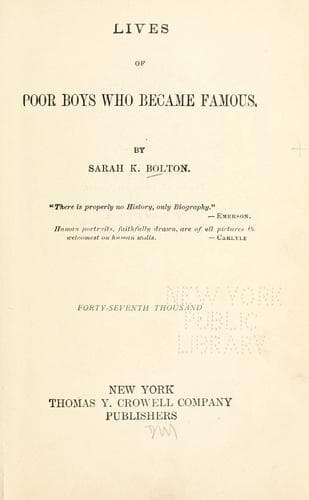
Lives of Poor Boys Who Became FamousBolton, Sarah Knowles
History
Lives of Poor Boys Who Became Famous
Bolton, Sarah Knowles
Biography
The body lay in state in the great music-room till a larger steamer came
to bear it to Bergen. This was met by a convoy of sixteen steamers
ranged on either side; and as the fleet approached the city, all flags
were at half-mast, and guns were fired, which re-echoed through the
mountains. The quay was covered with juniper, and the whole front
festooned with green. As the boat touched the shore, one of Ole Bull's
inimitable melodies was played. Young girls dressed in black bore the
trophies of his success, and distinguished men carried his gold crown
and order, in the procession. The streets were strewn with flowers, and
showered upon the coffin. When the service had been read at the grave by
the pastor, Bjornson, the famous author, gave an address. After the
coffin had been lowered and the mourners had departed, hundreds of
peasants came, bringing a green bough, a sprig of fern, or a flower, and
quite filled the grave. Beautiful tribute to a beautiful life!
[Illustration: MEISSONIER.]
MEISSONIER.
The old maxim, that "the gods reward all things to labor," has had fit
illustration in Meissonier. His has been a life of constant, unvaried
toil. He came to Paris a poor, unknown boy, and has worked over fifty
years, till he stands a master in French art.
Jean Louis Ernest Meissonier was born at Lyons, in 1811. His early life
was passed in poverty so grinding that the great artist never speaks of
it, and in such obscurity that scarcely anything is known of his
boyhood. At nineteen he came to Paris to try his fate in one of the
great centres of the world. He, of course, found no open doors, nobody
standing ready to assist genius. Genius must ever open doors for itself.
The lad was a close observer, and had learned to draw accurately. He
could give every variety of costume, and express almost any emotion in
the face of his subject. But he was unknown. He might do good work, but
nobody wanted it. He used to paint by the side of Daubigny in the
Louvre, it is said, for one dollar a yard. Now his "Amateurs in
Painting," a chef-d'oeuvre of six inches in size, is bought by Leon
Say for six thousand dollars. Such is fame.
Time was so necessary in this struggle for bread, that he could sleep
only every other night; and for six months his finances were so low, it
is stated, that he existed on ten cents a week! No wonder that the
sorrows of those days are never mentioned.
His earliest work was painting the tops of bon-bon boxes, and fans. Once
he grew brave enough to take four little sepia drawings to an editor to
illustrate a fairy tale in a magazine for children. The editor said the
drawings were charming, but he could not afford to have them engraved,
and so "returned them with thanks."
Public-domain text, read in full here on John Shaqi.
Reviews
Reviews
No reviews yet
Be the first to share your thoughts on this work.
Elsewhere in the archive
Join the Discussion
Join the discussion
Sign in to leave a comment or review.
Sign InorCreate an account