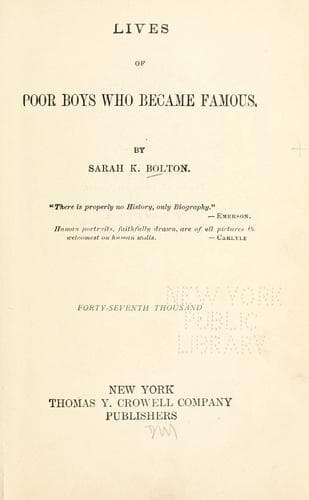
Lives of Poor Boys Who Became FamousBolton, Sarah Knowles
History
Lives of Poor Boys Who Became Famous
Bolton, Sarah Knowles
Biography
His first illustrations in some unknown journal were scenes from the
life of "The Old Bachelor." In the first picture he is represented
making his toilet before the mirror, his wig spread out on the table; in
the second, dining with two friends; in the third, being abused by his
housekeeper; in the fourth, on his death-bed, surrounded by greedy
relations; and in the fifth, the servants ransacking the death-chamber
for the property.
For a universal history he drew figures of Isaiah, St. Paul, and
Charlemagne, besides almost numberless ornamental letters and headings
of chapters. Of course he longed for more remunerative work, for fame;
but he must plod on for months yet. He worked conscientiously, taking
the greatest pains with every detail.
His first picture, exhibited in 1833, when he was twenty-two, called
"The Visitors," an interior view of a house, with an old gentleman
receiving two visitors, all dressed in the costume of James I.,
admirable for its light and shade, was bought by the Society of the
Friends of Art, for twenty dollars. Two years later he made
illustrations for the Bible of the Sieur Raymond, of Holofernes invading
Judea, and Judith appearing before Holofernes. For "Paul and Virginia"
he made forty-three beautiful landscapes. "They contain evidence of long
and careful work in the hot-houses of the 'Jardin des Plantes,' and in
front of the old bric-a-brac dealer's stalls, which used to stand about
the entrance to the Louvre. And how admirably, with the help of these
slowly and scrupulously finished studies, he could reproduce, in an
ornamental letter or floral ornament, a lily broken by the storm, or a
sheaf of Indian arms and musical instruments."
In 1836, his "Chess Players," two men watching intently the moves of
chess, and "The Little Messenger," attracted a crowd of admirers. Each
sold for twenty dollars. He had now struggled for six years in Paris. It
was high time that his unremitting and patient work should find
approval. The people were amazed at so vast an amount of labor in so
small a space. They looked with their magnifying glasses, and found the
work exquisite in detail. They had been accustomed to great canvases,
glowing colors, and heroic or romantic sentiments; but here there was
wonderful workmanship.
Public-domain text, read in full here on John Shaqi.
Reviews
Reviews
No reviews yet
Be the first to share your thoughts on this work.
Elsewhere in the archive
Join the Discussion
Join the discussion
Sign in to leave a comment or review.
Sign InorCreate an account