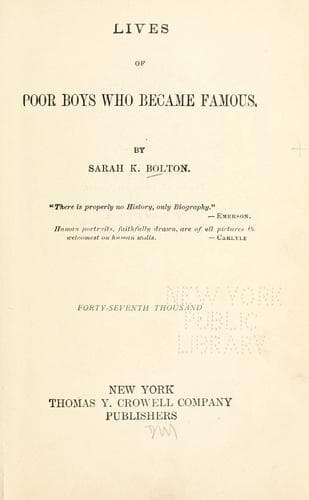
Lives of Poor Boys Who Became FamousBolton, Sarah Knowles
History
Lives of Poor Boys Who Became Famous
Bolton, Sarah Knowles
Biography
The following year, 1837, when he was twenty-eight, he was admitted to
the bar, and moved from New Salem to the larger town of Springfield,
forming a partnership with Mr. J. P. Stuart of whom he had borrowed his
law-books. Too poor even yet to pay much for board, he slept on a narrow
lounge in the law-office. He was again elected to the legislature, and
in the Harrison Presidential campaign, was chosen one of the electors,
speaking through the State for the Whig party. To so prominent a
position, already, had come the backwoods boy.
Four years after Ann Rutledge's death, he married, Nov. 4, 1839, Mary
Todd, a bright, witty, somewhat handsome girl, of good family, from
Kentucky. She admired his ability, and believed in his success; he
needed comfort in his utter loneliness. Till his death he was a true
husband, and an idolizing father to his children,--Robert, Willie, and
Tad (Thomas).
In 1846, seven years after his marriage, having steadily gained in the
reputation of an honest, able lawyer, who would never take a case unless
sure he was on the right side, Mr. Lincoln was elected to Congress by an
uncommonly large majority. Opposed to the war with Mexico, and to the
extension of slavery, he spoke his mind fearlessly. The "Compromise
measures of 1850," by which, while California was admitted as a free
State, and the slave-trade was abolished in the District of Columbia,
the Fugitive Slave Law was passed, giving the owners of slaves the right
to recapture them in any free State, had disheartened all lovers of
freedom. Lincoln said gloomily to his law partner, Mr. Herndon, "How
hard, oh, how hard it is to die and leave one's country no better than
if one had never lived for it!"
His father died about this time, his noble son sending him this message,
"to remember to call upon and confide in our great and good and merciful
Maker, who will not turn away from him in any extremity. He notes the
fall of the sparrow, and numbers the hairs of our heads; and He will not
forget the dying man who puts his trust in Him."
In 1854, through the influence of Stephen A. Douglas, a brilliant
senator from Illinois, the Kansas-Nebraska Act was passed, whereby
those States were left to judge for themselves whether they would have
slaves or not. But by the Missouri Compromise of 1820, it was expressly
stated that slavery should be forever prohibited in this locality. The
whole North grew to white heat. When Douglas returned to his Chicago
home the people refused to hear him speak. Illinois said, "His arguments
must be answered, and Abraham Lincoln is the man to answer them!"
Public-domain text, read in full here on John Shaqi.
Reviews
Reviews
No reviews yet
Be the first to share your thoughts on this work.
Elsewhere in the archive
Join the Discussion
Join the discussion
Sign in to leave a comment or review.
Sign InorCreate an account