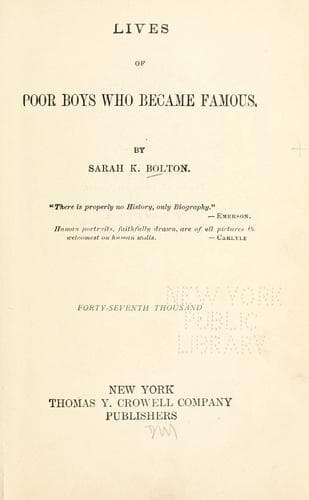
Lives of Poor Boys Who Became FamousBolton, Sarah Knowles
History
Lives of Poor Boys Who Became Famous
Bolton, Sarah Knowles
Biography
At the State Fair at Springfield, in October, a great company were
gathered. Douglas spoke with marked ability and eloquence, and then on
the following day, Abraham Lincoln spoke for three hours. His heart was
in his words. He quivered with emotion. The audience were still as
death, but when the address was finished, men shouted and women waved
their handkerchiefs. Lincoln and the right had triumphed. After this,
the two men spoke in all the large towns of the State, to immense
crowds. The Kansas-Nebraska Bill worked out its expected results. Blood
flowed in the streets, as pro-slavery and anti-slavery men contested the
ground, newspaper offices were torn down by mobs, and Douglas lost the
great prize he had in view,--the Presidency of the United States.
When the new party, the Republican, held its second convention in
Philadelphia, June 17, 1856, Abraham Lincoln received one hundred and
ten votes for Vice President. What would Nancy Hanks Lincoln have said
if she could have looked now upon the boy to whom she taught the Bible
in the log cabin!
An incident occurred about this time which increased his fame. A man was
murdered at a camp-meeting, and two young men were arrested. One was a
very poor youth, whose mother, Hannah Armstrong, had been kind to
Lincoln in the early years. She wrote to the prominent lawyer about her
troubles, because she believed her son to be innocent. The trial came
on. The people were clamorous for Armstrong to be hanged. The principal
witness testified that "by the aid of the brightly shining moon, he saw
the prisoner inflict the death-blow with a slung shot."
After careful questioning, Mr. Lincoln showed the perjury of the
witness, by the almanac, no moon being visible on the night in question.
The jury were melted to tears by the touching address, and their
sympathy went out to the wronged youth and his poor old mother, who
fainted in his arms. Tears, too, poured down the face of Mr. Lincoln, as
the young man was acquitted. "Why, Hannah," he said, when the grateful
woman asked what she should try to pay him, "I shan't charge you a cent;
never." She had been well repaid for her friendliness to a penniless
boy.
Public-domain text, read in full here on John Shaqi.
Reviews
Reviews
No reviews yet
Be the first to share your thoughts on this work.
Elsewhere in the archive
Join the Discussion
Join the discussion
Sign in to leave a comment or review.
Sign InorCreate an account