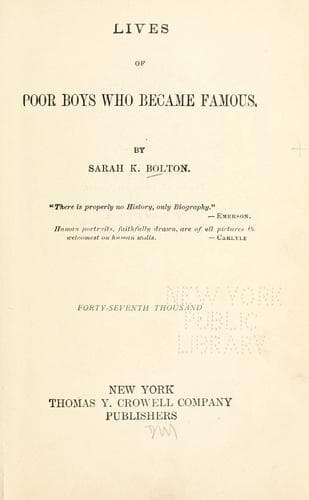
Lives of Poor Boys Who Became FamousBolton, Sarah Knowles
History
Lives of Poor Boys Who Became Famous
Bolton, Sarah Knowles
Biography
The resulting canvass was one of the most remarkable in our history. The
South said, "War will result if he is elected." The North said, "The
time has come for decisive action." The popular vote for Abraham Lincoln
was nearly two millions (1,857,610), while Stephen A. Douglas received
something over a million (1,291,574). The country was in a fever of
excitement. The South made itself ready for war by seizing the forts.
Before the inauguration most of the Southern States had seceded.
Sad farewells were uttered as Mr. Lincoln left Springfield for
Washington. To his law partner he said, "You and I have been together
more than twenty years, and have never passed a word. Will you let my
name stay on the old sign till I come back from Washington?"
The tears came into Mr. Herndon's eyes, as he said, "I will never have
any other partner while you live," and he kept his word. Old Hannah
Armstrong told him that she should never see him again; that something
told her so; his enemies would assassinate him. He smiled and said,
"Hannah, if they do kill me, I shall never die another death."
He went away without fear, but feeling the awful responsibility of his
position. He found an empty treasury and the country drifting into the
blackness of war. He spoke few words, but the lines grew deeper on his
face, and his eyes grew sadder.
In his inaugural address he said, "In your hands, my dissatisfied
fellow-countrymen, and not in mine, is the momentous issue of civil war.
The government will not assail you. You can have no conflict without
being yourselves the aggressors.... Physically speaking we cannot
separate."
The conflict began April 12, 1861, by the enemy firing on Fort Sumter.
That sound reverberated throughout the North. The President called for
seventy-five thousand men. The choicest from thousands of homes quickly
responded. Young men left their college-halls and men their places of
business. "The Union must and shall be preserved," was the eager cry.
Then came the call for forty-two thousand men for three years.
The President began to study war in earnest. He gathered military books,
sought out on maps every creek and hill and valley in the enemy's
country, and took scarcely time to eat or sleep. May 24, the brilliant
young Colonel Ellsworth had been shot at Alexandria by a hotel-keeper,
because he pulled down the secession flag. He was buried from the east
room in the White House, and the North was more aroused than ever. The
press and people were eager for battle, and July 21, 1861, the Union
army, under General McDowell, attacked the Confederates at Bull Run and
were defeated. The South was jubilant, and the North learned, once for
all, that the war was to be long and bloody. Congress, at the request of
the President, at once voted five hundred thousand men, and five hundred
million dollars to carry on the war.
Public-domain text, read in full here on John Shaqi.
Reviews
Reviews
No reviews yet
Be the first to share your thoughts on this work.
Elsewhere in the archive
Join the Discussion
Join the discussion
Sign in to leave a comment or review.
Sign InorCreate an account