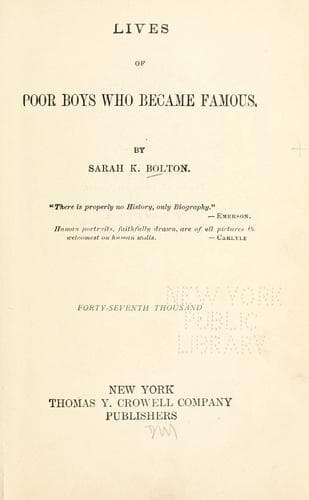
Lives of Poor Boys Who Became FamousBolton, Sarah Knowles
History
Lives of Poor Boys Who Became Famous
Bolton, Sarah Knowles
Biography
Vast work was to be done. The Southern ports must be blockaded, and the
traffic on the Mississippi River discontinued. A great and brave army of
Southerners, fighting on their own soil, every foot of which they knew
so well, must be conquered if the nation remained intact. The burdens of
the President grew more and more heavy. Men at the North, who
sympathized with the South,--for we were bound together as one family
in a thousand ways,--said the President was going too far in his
authority; others said he moved too slowly, and was too lenient to the
slave power. The South gained strength from the sympathy of England, and
only by careful leadership was war avoided with that country.
General McClellan had fought some hard battles in Virginia--Fair Oaks,
Mechanicsville, Malvern Hill, and others--with varying success, losing
thousands of men in the Chickahominy swamps, and after the battle of
Antietam, Sept. 17, 1862, one of the severest of the war, when each side
lost over ten thousand men, he was relieved of his command, and
succeeded by General Burnside. There had been some successes at the West
under Grant, at Fort Donelson and Shiloh, and at the South under
Farragut, but the outlook for the country was not hopeful. Mr. Lincoln
had met with a severe affliction in his own household. His beautiful son
Willie had died in February. He used to walk the room in those dying
hours, saying sadly, "This is the hardest trial of my life; why is it?
why is it?"
This made him, perhaps, even more tender of the lives of others' sons. A
young sentinel had been sentenced to be shot for sleeping at his post;
but the President pardoned him, saying, "I could not think of going into
eternity with the blood of the poor young man on my skirts. It is not to
be wondered at that a boy raised on a farm, probably in the habit of
going to bed at dark, should, when required to watch, fall asleep, and I
cannot consent to shoot him for such an act." This youth was found among
the slain on the field of Fredericksburg, wearing next his heart a
photograph of his preserver, with the words, "God bless President
Lincoln."
An army officer once went to Washington to see about the execution of
twenty-four deserters, who had been sentenced by court-martial to be
shot. "Mr. President," said he, "unless these men are made an example
of, the army itself is in danger. Mercy to the few is cruelty to the
many."
"Mr. General," was the reply, "there are already too many weeping widows
in the United States. For God's sake, don't ask me to add to the number,
for I won't do it." At another time he said, "Well, I think the boy can
do us more good above ground than under ground."
Public-domain text, read in full here on John Shaqi.
Reviews
Reviews
No reviews yet
Be the first to share your thoughts on this work.
Elsewhere in the archive
Join the Discussion
Join the discussion
Sign in to leave a comment or review.
Sign InorCreate an account