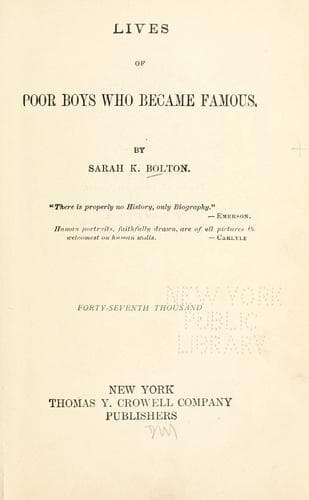
Lives of Poor Boys Who Became FamousBolton, Sarah Knowles
History
Lives of Poor Boys Who Became Famous
Bolton, Sarah Knowles
Biography
On Nov. 19, of this year, this battle-field was dedicated, with solemn
ceremonies, as one of the national cemeteries. Mr. Lincoln made a very
brief address, in words that will last while America lasts, "The world
will little note, nor long remember, what we say here; but it can never
forget what they did here. It is for us, the living, rather, to be
dedicated here to the unfinished work which they who fought here have
thus far so nobly advanced. It is, rather, for us to be here dedicated
to the great task remaining for us, that from these honored dead we take
increased devotion to the cause for which they gave the last full
measure of devotion; that we here highly resolve that these dead shall
not have died in vain; that this nation, under God, shall have a new
birth of freedom, and that the government of the people, by the people,
and for the people, shall not perish from the earth."
Emerson says of these words, "This, and one other American speech, that
of John Brown to the court that tried him, and a part of Kossuth's
speech at Birmingham, can only be compared with each other, and no
fourth."
The next year, Feb. 29, 1864, the Hero of Vicksburg was called to the
Lieutenant-Generalship of the army, and for the first time Mr. Lincoln
felt somewhat a sense of relief from burdens. He said, "Wherever Grant
is, things move." He now called for five hundred thousand more men, and
the beginning of the end was seen. Sherman swept through to the sea.
Grant went below Richmond, where he said, "I propose to fight it out on
this line if it takes all summer."
Mr. Lincoln had been re-elected to the Presidency for a second term,
giving that beautiful inaugural address to the people, "With malice
toward none, with charity for all, with firmness in the right, as God
gives us to see the right, let us strive on to finish the work we are
in; to bind up the nation's wounds; to care for him who shall have borne
the battle, and for his widows and orphans; to do all which may achieve
and cherish a just and lasting peace among ourselves and with all
nations." On April 9, 1865, Lee surrendered to Grant at Appomattox, and
the long war was ended. The people gathered in their churches to praise
God amid their tears. Abraham Lincoln's name was on every lip. The
colored people said of their deliverer, "He is eberywhere. He is like de
bressed Lord; he walks de waters and de land."
An old colored woman came to the door of the White House and met the
President as he was coming out, and said she wanted to see "Abraham the
Second."
"And who was Abraham the First?" asked the good man.
"Why, Lor' bless you, we read about Abraham de First in de Bible, and
Abraham de Second is de President."
"Here he is!" said the President, turning away to hide his tears.
Well did the noble-hearted man say, "I have never willingly planted a
thorn in any man's bosom."
Public-domain text, read in full here on John Shaqi.
Reviews
Reviews
No reviews yet
Be the first to share your thoughts on this work.
Elsewhere in the archive
Join the Discussion
Join the discussion
Sign in to leave a comment or review.
Sign InorCreate an account