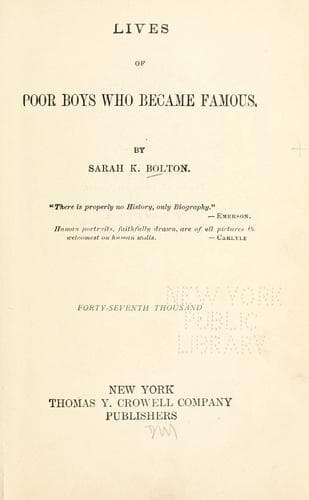
Lives of Poor Boys Who Became FamousBolton, Sarah Knowles
History
Lives of Poor Boys Who Became Famous
Bolton, Sarah Knowles
Biography
A woman in a faded shawl and hood came to see the President, begging
that, as her husband and all her sons--three--had enlisted, and her
husband had been killed, he would release the oldest, that he might care
for his mother. Mr. Lincoln quickly consented. When the poor woman
reached the hospital where her boy was to be found, he was dead.
Returning sadly to Mr. Lincoln, he said, "I know what you wish me to do
now, and I shall do it without your asking; I shall release your second
son.... Now _you_ have one, and _I_ one of the other two left: that is
no more than right." Tears filled the eyes of both as she reverently
laid her hand on his head, saying, "The Lord bless you, Mr. President.
May you live a thousand years, and always be at the head of this great
nation!"
Through all these months it had become evident that slavery must be
destroyed, or we should live over again these dreadful war-scenes in
years to come. Mr. Lincoln had been waiting for the right time to free
the slaves. General McClellan had said, "A declaration of radical views,
especially upon slavery, will rapidly disintegrate our present armies";
but Sept. 22, 1862, Mr. Lincoln told his Cabinet, "I have promised my
God that I will do it"; and he issued the immortal Emancipation
Proclamation, by which four million human beings stepped out from
bondage into freedom. He knew what he was doing. Two years afterward he
said, "It is the central act of my administration, and the great event
of the nineteenth century."
The following year, 1863, brought even deeper sorrows. The "Draft Act,"
by which men were obliged to enter the army when their names were drawn,
occasioned in July a riot in New York city, with the loss of many lives.
Grant had taken Vicksburg on July 4, and General Meade had won at the
dreadful three days' fight at Gettysburg, July 1-4, with a loss of more
than twenty thousand on either side; but the nation was being held
together at a fearful cost. When Mr. Lincoln announced to the people
the victory at Gettysburg, he expressed the desire that, in the
customary observance of the Fourth of July, "He whose will, not ours,
should everywhere be done, be everywhere reverenced with profoundest
gratitude." He reverenced God, himself, most devoutly. "I have been
driven many times upon my knees," he said, "by the overwhelming
conviction that I had nowhere else to go. My own wisdom and that of all
about me seemed insufficient for that day."
Public-domain text, read in full here on John Shaqi.
Reviews
Reviews
No reviews yet
Be the first to share your thoughts on this work.
Elsewhere in the archive
Join the Discussion
Join the discussion
Sign in to leave a comment or review.
Sign InorCreate an account