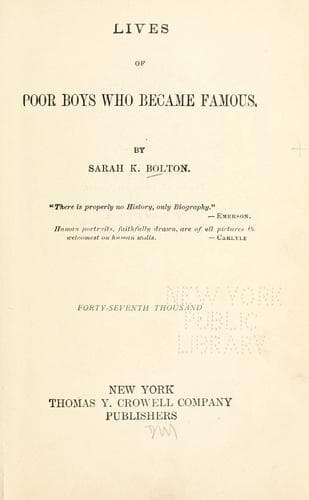
Lives of Poor Boys Who Became FamousBolton, Sarah Knowles
History
Lives of Poor Boys Who Became Famous
Bolton, Sarah Knowles
Biography
Perhaps the most interesting of all Mr. Salt's gifts to his workmen is
the Saltaire Club and Institute, costing $125,000; a handsome building,
with large reading-room supplied with daily papers and current
literature, a library, lecture-hall for eight hundred persons, a "School
of Art," with models, drawings, and good teachers, a billiard-room with
four tables, a room for scientific study, each student having proper
appliances for laboratory work, a gymnasium and drill-room nearly sixty
feet square, an armory for rifle-practice, and a smoking-room, though
Mr. Salt did not smoke. The membership fee for all this study and
recreation is only thirty seven cents for each three months. Opposite
the great mill is a dining-hall, where a plate of meat can be purchased
for four cents, a bowl of soup for two cents, and a cup of tea or coffee
for one cent. If the men prefer to bring their own food, it is cooked
free of charge. The manager has a fixed salary, so that there is no
temptation to scrimp the buyers.
Still another gift was made to the work-people; a park of fourteen
acres, with croquet and archery grounds, music pavilion, places for
boating and swimming, and walks with beautiful flowers. No saloon has
ever been allowed in Saltaire. Without the temptation of the beer-shops,
the boys have grown to intelligent manhood, and the girls to virtuous
womanhood. Sir Titus Salt's last gift to his workmen was a Sunday-school
building costing $50,000, where are held the "model Sunday schools of
the country," say those who have attended the meetings. No wonder, at
the death of this man, 40,000 people came to his burial,--members of
Parliament, clergymen, workingmen's unions, and ragged schools. No
wonder that statues have been erected to his memory, and that thousands
go every year to Saltaire, to see what one capitalist has done for his
laborers. No fear of strikes in his workshops; no socialism talked in
the clean and pretty homes of the men; no squalid poverty, no depraving
ignorance.
That capital is feeling its responsibility in this matter of homes for
laborers is one of the hopeful signs of the times. We shall come,
sometime, to believe with the late President Chadbourne, "The rule now
commonly acted upon is that business must be cared for, and men must
care for themselves. The principle of action, in the end, must be that
_men must be cared for_, and business must be subservient to this great
work."
If, as Spurgeon has well said, "Home is the grandest of all
institutions," capital can do no better work than look to the homes of
the laborer. It is not the mansion which the employer builds for
himself, but the home which he builds for his employe, which will insure
a safe country for his children to dwell in. If discontent and poverty
surround his palace, its foundations are weak; if intelligence has been
disseminated, and comfort promoted by his unselfish thought for others,
then he leaves a goodly heritage for his children.
Public-domain text, read in full here on John Shaqi.
Reviews
Reviews
No reviews yet
Be the first to share your thoughts on this work.
Elsewhere in the archive
Join the Discussion
Join the discussion
Sign in to leave a comment or review.
Sign InorCreate an account