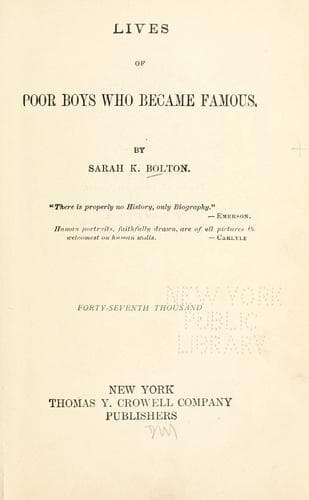
Lives of Poor Boys Who Became FamousBolton, Sarah Knowles
History
Lives of Poor Boys Who Became Famous
Bolton, Sarah Knowles
Biography
JOSEPH MARIE JACQUARD.
The small world which lives in elegant houses knows little of the great
world in dingy apartments with bare walls and empty cupboards. Those who
walk or ride in the sunshine often forget the darkness of the mines, or
the tiresome treadmill of the factories.
Over a century ago, in Lyons, France, lived a man who desired to make
the lives of the toilers brighter and happier. Joseph Jacquard, the son
of a silk-weaver who died early, began his young manhood, the owner of
two looms and a comfortable little home. He had married Claudine
Boichon, the daughter of a goldsmith who expected to give his daughter a
marriage portion, but was unable from loss of property. Jacquard loved
her just as devotedly, however, as though she had brought him money. A
pretty boy was born into their home, and no family was happier in all
France. But the young loom-owner saw the poor weavers working from four
in the morning till nine at night, in crowded rooms, whole families
often bending over a loom, their chests shrunken and their cheeks
sallow from want of air and sunlight; and their faces dull and vacant
from the monotony of unvaried toil. There were no holidays, no walks in
the fields among the flowers, no reading of books, nothing but the
constant routine which wore out body and mind together. There was no
home-life; little children grew pinched and old; and mothers went too
early to their graves. If work stopped, they ate the bread of charity,
and went to the almshouse. The rich people of Lyons were not
hard-hearted, but they did not _think_; they were too busy with their
parties and their marriages; too busy buying and selling that they might
grow richer. But Jacquard was always thinking how he could lighten the
labor of the silk-weavers by some invention.
The manufacture of silk had become a most important industry. Seventeen
hundred years before Christ the Chinese had discovered the making of
silk from silk-worms, and had cultivated mulberry-trees. They forbade
anybody to export the eggs or to disclose the process of making the
fabric, under penalty of death. The Roman Emperor Justinian determined
to wrest this secret from China, and thus revive the resources of his
empire. He sent two monks, who ostensibly preached Christianity, but in
reality studied silk-worms, and, secreting some eggs in two hollow
reeds, returned to Justinian, and breaking these canes, laid the eggs on
the lap of the beautiful Empress Theodora. From this the art spread into
Italy, and thence into France.
Public-domain text, read in full here on John Shaqi.
Reviews
Reviews
No reviews yet
Be the first to share your thoughts on this work.
Elsewhere in the archive
Join the Discussion
Join the discussion
Sign in to leave a comment or review.
Sign InorCreate an account