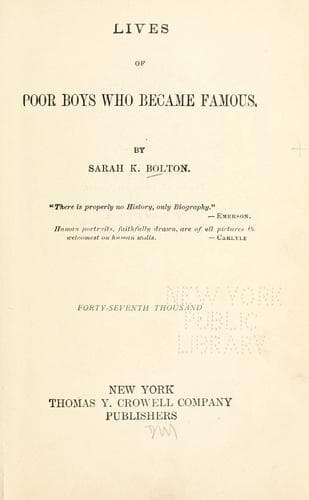
Lives of Poor Boys Who Became FamousBolton, Sarah Knowles
History
Lives of Poor Boys Who Became Famous
Bolton, Sarah Knowles
Biography
Did one failure discourage him? Oh, no! He went to Boston, and found a
place in a printing office. He soon became the editor of the "National
Philanthropist," the first paper established to advocate total
abstinence from intoxicants. His motto was a true one, not very popular,
however, in those days, "Moderate drinking is the down-hill road to
drunkenness." He was now twenty-two, poor, but God-fearing and
self-reliant. About this time there came to Boston a man whose influence
changed young Garrison's whole life,--Benjamin Lundy, a Quaker,
thirty-nine years of age. Leaving his father's home at nineteen, he had
spent four years at Wheeling, Va., where he learned the saddler's trade,
and learned also the cruelties of slave-holding. After this he moved to
Ohio, and in four years earned three thousand dollars above his living
expenses. When he was twenty-six he organized an Anti-slavery Society at
his own house, and, promising to become assistant editor of an abolition
paper, he went to St. Louis to dispose of his stock of saddlery.
Business was greatly depressed, the whole region being agitated over the
admission of Missouri as a slave State; and, after spending two years,
Lundy returned to Ohio, on foot, in winter, his property entirely gone.
None of his ardor for freedom having abated, he determined to start a
monthly paper, though poor and entirely ignorant about printing. This
sheet he called the "Genius of Universal Emancipation," printed twenty
miles from his home, the edition being carried on his back, each month,
as he walked the long distance. He moved shortly after to East
Tennessee, walking half of the eight hundred miles, and gradually
increased his subscription list. Several times his life was in danger;
but the slight, gentle Quaker kept quietly on his course. In 1824 he set
out on foot for Baltimore, paying his way by saddlery or
harness-mending, living on the poorest fare; and he subsequently
established the "Genius" there. While he was absent from home, his wife
died, leaving twins, and his five children were divided among friends.
Deeply sorrowing, he renewed his resolve to devote his life to worse
than motherless children,--those sold into bondage,--and made his way as
best he could to Boston. Of such material were the foundation stones of
the anti-slavery cause.
At his boarding-place Lundy met Garrison, and told him his burning
desire to rid the country of slavery. The heart of the young printer was
deeply moved. He, too, was poor and unknown, but he had not forgotten
his mother's teachings and prayers. After some time he agreed to go to
Baltimore, and help edit the "Genius of Universal Emancipation." Lundy
was in favor of sending the slaves to the West Indies or Africa as fast
as their masters would consent to free them, which was not very fast.
Garrison said, "The slaves are here by no fault of their own, and do not
deserve to be sent back to barbarous Africa." He was in favor of
immediate freedom for every human being.
Public-domain text, read in full here on John Shaqi.
Reviews
Reviews
No reviews yet
Be the first to share your thoughts on this work.
Elsewhere in the archive
Join the Discussion
Join the discussion
Sign in to leave a comment or review.
Sign InorCreate an account