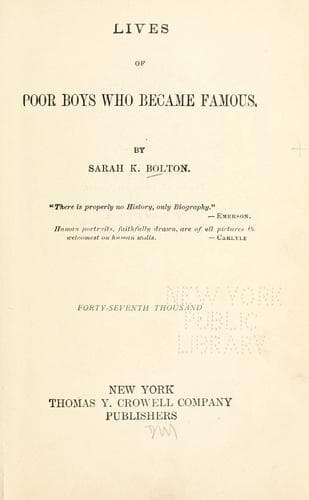
Lives of Poor Boys Who Became FamousBolton, Sarah Knowles
History
Lives of Poor Boys Who Became Famous
Bolton, Sarah Knowles
Biography
Baltimore had slave-pens on the principal streets. Vessel-loads of
slaves, torn from their homes, were sent hundreds of miles away to
southern ports, and the auction-block often witnessed heart-rending
scenes. The tender heart of Garrison was stirred to its very depths. In
the first issue of his paper he declared for Immediate Emancipation, and
soon denounced the slave-trade between Baltimore and New Orleans as
"domestic piracy," giving the names of several citizens engaged in the
traffic, among them a vessel-owner from his own town, Newburyport. The
Northern man immediately arrested Garrison for "gross and malicious
libel," and he was found guilty by a slave-holding court, and fined
fifty dollars and costs. No one was ready to give bail, and he was
thrown into prison. The young man was not in the least cast down, but,
calm and heroic, wrote two sonnets on the walls of his cell.
Meantime, a noble young Quaker at the North, John G. Whittier, was
deeply anxious for Garrison. He had no money to pay his fine, but,
greatly admiring Henry Clay, whom he hoped to see President, wrote him
urging that he aid the "guiltless prisoner." Clay would doubtless have
done so, but Arthur Tappan, one of New York's noble men, sent the money,
releasing Garrison from his forty-nine days' imprisonment. Wendell
Phillips says of him, "He was in jail for his opinions when he was just
twenty-four. He had confronted a nation in the very bloom of his youth."
Garrison had not been idle while in prison. He had prepared several
lectures on slavery, and these he now gave when he could find a hearing.
Large churches were not opened to him, and nobody offered him two
hundred dollars a night! The free colored people welcomed him gladly,
but the whites were usually indifferent or opposed to such "fanatical"
ideas. At last he came to Boston to start a paper,--that city where
brains and not wealth open the doors to the best society. Here, with no
money nor influential friends, he started the "Liberator," with this for
his motto, "I will be as harsh as truth and as uncompromising as
justice. On this subject I do not wish to speak or write with
moderation. I am in earnest. I will not equivocate; I will not excuse; I
will not retreat a single inch--_and I will be heard!_"
Public-domain text, read in full here on John Shaqi.
Reviews
Reviews
No reviews yet
Be the first to share your thoughts on this work.
Elsewhere in the archive
Join the Discussion
Join the discussion
Sign in to leave a comment or review.
Sign InorCreate an account