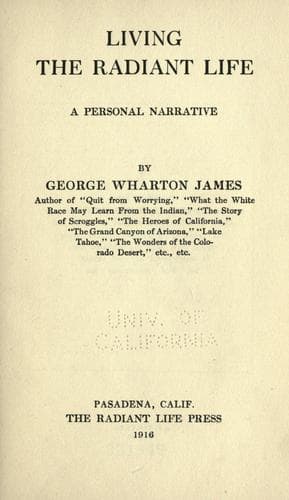
Living the Radiant Life: A Personal NarrativeJames, George Wharton
Religion
Living the Radiant Life: A Personal Narrative
James, George Wharton
Conduct of life
Yet, in spite of this large-hearted contentment with things as they are,
and with the way the world generally is progressing, which I would
radiate, I would equally radiate a great discontent with many things as
they are. When I look at my own faults and failings, my inadequacies and
incompetencies, my blindness and stupidity, my ignorance and
willfulness, I find much of my content disappear like the airy visions
of a dream. I certainly do not want to be content with these things and
so I call up as often as I can a mighty discontent which is a constant
urge to the higher, nobler, truer, better life. I am as self-willed as
other men, and yet I well know that human will is both ignorant and
blind, and that only when it is made subject to the Great Controlling
Will of the Universe will it lead me aright and in the paths of
ultimate, permanent success. And by success, I do not mean the paltry
thing most men regard as success. I certainly wish to radiate discontent
with what men generally regard as success. Mere money, fame, honor,
social distinction, count for little unless character, divine sympathy
with one's needy fellows, and an enlarged conception of the brotherhood
of men accompany them.
And how can I do other than radiate a large and tremendous discontent at
the suffering and woe of the unfortunates of life? It is little or
nothing to me what causes their misfortune. I have learned that the
judgment of sociologists, theologists, and reformers generally is of
little account in interpreting the causes of things. As a rule, they
look only on the surface and see nothing of the hidden springs of action
and therefore know little of the movement of hearts of men and women
whose condition they so complacently and conceitedly imagine they can
change.
Some years ago, Jack London wrote a book entitled, _The People of the
Abyss_. It was severely censured and criticised and some critics went so
far as to assert that it was full of untruths. It told of the dismal
lives of London's poor, who daily find themselves with nothing but one
meal, two meals, three meals between themselves and starvation--poor
wretches to whom the "wolf at the door" is an ever present reality, and
who tremble every time their employers look towards them with a frown or
speak with a voice that threatens dismissal. What a frightful,
pitiable, pathetic position for men and women--my brothers and
sisters--to be in. I certainly do not wish to radiate contentment at the
fact of their unfortunate condition. I want somehow to take some of
their burdens upon my life. I want to realize something of the spirit
that led Walt Whitman to exclaim, "I will take nothing for myself that
cannot be given upon equal terms to all men."
Public-domain text, read in full here on John Shaqi.
Reviews
Reviews
No reviews yet
Be the first to share your thoughts on this work.
Elsewhere in the archive
Join the Discussion
Join the discussion
Sign in to leave a comment or review.
Sign InorCreate an account