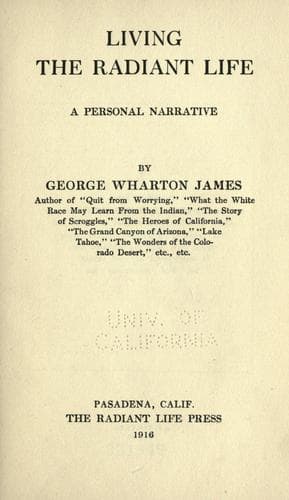
Living the Radiant Life: A Personal NarrativeJames, George Wharton
Religion
Living the Radiant Life: A Personal Narrative
James, George Wharton
Conduct of life
When I read the stories of child labor and learn of the many cruelties
practiced upon helpless little ones, in the name of business; when I see
those boys and girls of tender age in the cotton mills of the South,
owned by wealthy men of the North, plodding back and forth, hour by
hour, behind the whirling spindles; when I see them, as I have often
done, so utterly weary that when the noon hour came, they would stretch
out on the bare floor and try to gain a little snatch of forgetfulness
of their weariness in sleep, rather than eat their inadequate lunch, I
have certainly felt, as I now feel, that I wish to radiate a tremendous
amount of discontent that such inhuman facts can exist. When I see the
private palace car owned by the many-times millionaire, and catch
glimpses of the extravagant and wasteful luxury in which he and his
family live, and realize that this prodigal wastefulness is made
possible by the life-destroying labor of poor, anæmic children in the
glass-blowing factories of New Jersey, I wish I had the power to send a
great wail of discontent through the country that would thrill the
hearts, awaken the senses, and arouse the consciences of every man and
woman in the nation.
When I realize the inadequacies of our legal system to do justice alike
to all men and women, the poor as well as the rich, the innocent and
confiding as well as the crafty and cunning, I feel nothing but
discontent and long for the time to come when justice and mercy shall be
of higher value in the courts of our land than precedent and legal
procedure.
It often takes moral courage to radiate real living discontent with
these injustices and crimes against our needy and defenseless fellows. I
long to possess this moral courage in fullest measure, and to radiate it
on every hand. In view of the need for strong protest against the smug,
contented betrayers of the poor and needy, I would radiate a spirit that
has not inaptly been termed that of _contemporaneous protest and
rebellion_. By this I mean that present spirit of protest and rebellion
against wrongs that exist _now_, so that my protest will be
contemporaneous with the evil.
It is easy enough to line up with the winning side and shout Hurrah!
with the victors in any conflict. Even the English of to-day agree that
the American Revolution was a good thing and that the acts of George III
were indefensible tyranny. But it required considerable courage to join
one's forces with those of Washington when money was scarce and men few,
when the day seemed dark and gloomy, and the prospects of success were
doubtful.
It is easy enough to-day to Hurrah! for the principles of Lincoln, but
many a great statesman like Henry Clay felt it was better to compromise
than face the fierce antagonism of such men as Calhoun, Jefferson Davis,
and others who believed in the opposing ideas.
Public-domain text, read in full here on John Shaqi.
Reviews
Reviews
No reviews yet
Be the first to share your thoughts on this work.
Elsewhere in the archive
Join the Discussion
Join the discussion
Sign in to leave a comment or review.
Sign InorCreate an account