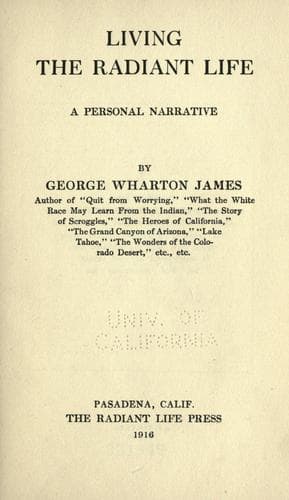
Living the Radiant Life: A Personal NarrativeJames, George Wharton
Religion
Living the Radiant Life: A Personal Narrative
James, George Wharton
Conduct of life
Sometimes we meet with those who will refuse to do certain things
because they regard them as more menial than those they were engaged to
perform, as, for instance, the case of a bell boy who refused to take
away a coal-scuttle when asked to do so because that was not in the list
of his duties, and a man "lower down in the scale" was supposed to
attend to work of that kind. Now, while I recognize that there must be
for convenience's sake, a division of labor, I want to radiate the
feeling and belief that there is no higher, no lower, in this call of
personal service. It is just as honorable to be a street sweeper or a
scavenger of the meanest kind (so-called), to be a farm laborer, to be a
kitchen drudge, to be a factory hand, as it is to be a minister of a
church that pays a salary of $20,000 a year. The real blessedness of
life of all grades of service from the scavenger to the expensive pastor
is determined by the _spirit_ behind the service, and the kitchen drudge
who does her work with the consciousness in her own soul that she is
gladly, merrily, cheerfully undertaking her work and doing it well for
the comfort, benefit, cheer, and blessing of her employers is of more
benefit to mankind than the services of the expensive pastor of the
exclusive church who regards his ministry as a proof of his own
intellectual worth, and as a means of asserting his high social
position.
Who can ever forget the wonderful picture of that sturdy Scotch Doctor
depicted by Ian Maclaren in his _Bonnie Brier Bush_, whose passion of
devotion and ministry was so pure that it reached every soul in the
whole region.
Frances Hodgson Burnett, in her _Dawn of a To-morrow_, tells of a
degraded street waif who yet had this passion of ministry in her soul,
and I have come to the conclusion that wherever it is found, it is
divine, and therefore blessed. Hence I would radiate it at all times,
under all conditions, and under all circumstances to all classes and
conditions of men.
Where would have been the work of Judge Lindsay of Denver, Golden Rule
Jones of Toledo, McClaughery of Elmira Penitentiary, Chief Kohler of
Cleveland, Governor Hunt and Warden Sims of Arizona, if they had worked
only for the worthy? It was the very openness of the unworthiness of
those for whom they strove, that made the appeal to these large-hearted
men.
It is so easy to criticise men of this stamp because they have dared to
break away from the conventional rendering of service only to the
worthy. It is so easy to cry that they are doing more harm than good.
But those who know the work and know the hearts that are constantly
being touched and molded into betterment by it are better able to judge
of its higher results.
Public-domain text, read in full here on John Shaqi.
Reviews
Reviews
No reviews yet
Be the first to share your thoughts on this work.
Elsewhere in the archive
Join the Discussion
Join the discussion
Sign in to leave a comment or review.
Sign InorCreate an account